
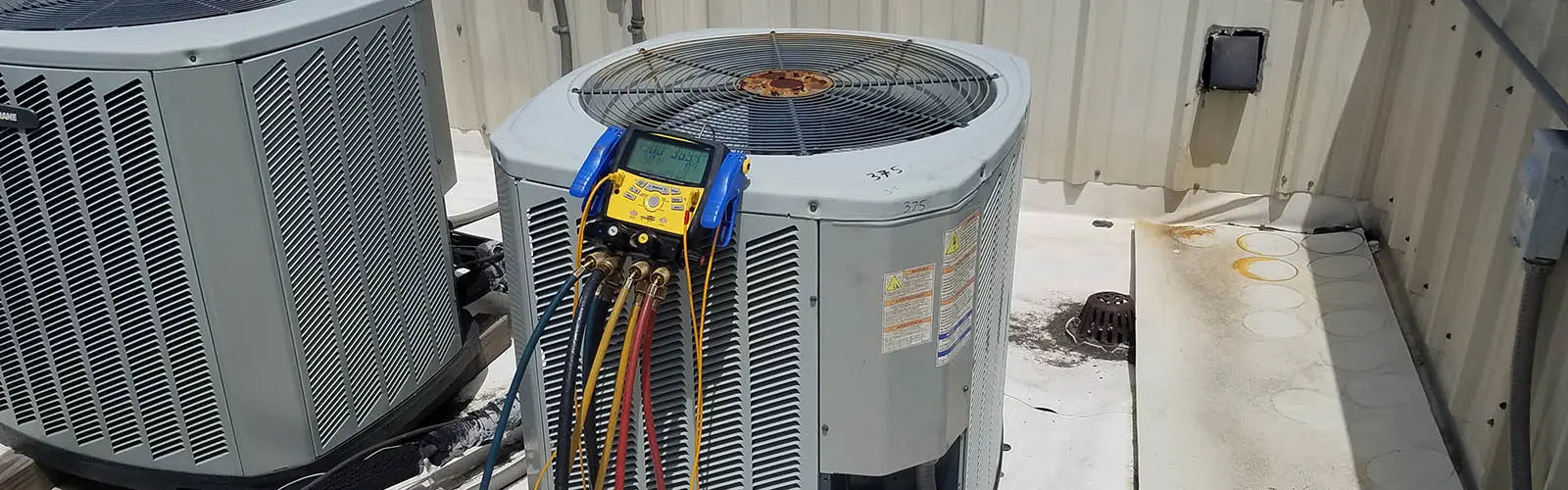
Commercial HVAC Installation & Replacement in Houston
QUICK ANSWER
Castle Air Conditioning & Heating installs and replaces commercial HVAC across Houston, Fort Bend County and the Bay Area: rooftop units, packaged systems, commercial splits and dedicated server-room cooling. We size the system to the building rather than copying what came off the roof, we plan the crane lift and the curb before quoting, and we schedule the work around your trading hours. Every quote follows a site visit. Call or text (713) 667-7606.
System down right now?
This page is about planned replacement. If a unit has failed and the building is getting hot, start with commercial HVAC repair or call (713) 667-7606. We answer 24 hours a day, and plenty of systems we are asked to replace can be repaired for a fraction of the cost.
Replace, or keep repairing?
For a business the arithmetic is different from a house, because the cost of the equipment is not the only cost. Downtime is the expensive part.
Age and what has failed. A contactor or a belt is a repair at almost any age. A failed compressor on a fifteen-year-old rooftop unit is a decision, because you are spending a meaningful share of a replacement on a cabinet whose coils, motors and controls are all the same age.
How often you are calling somebody out. One breakdown is bad luck. Three in a season is a pattern, and the invoices plus the disruption usually add up to more than the amortised cost of new equipment.
What it is costing you to run. Older commercial equipment is single-stage and runs at full output or not at all. Current equipment modulates. On a building that runs eleven months a year in this climate, that gap shows up on the utility bill.
Refrigerant. Systems still on R-22 are the clearest case. The refrigerant is no longer produced, so a significant leak on an R-22 machine is often the end of it. Systems on R-410A are fine to keep running, but see the section below before you plan a phased replacement.
We will tell you when repair is still the better spend. We would rather do a maintenance agreement for five years than sell you a unit you did not need.
What actually drives the scope of a commercial replacement
Two identical-looking buildings on the same street can need very different jobs. This is why we will not quote a rooftop unit over the phone.
| What we look at | Why it changes the job |
|---|---|
| Actual load, not the old nameplate | Buildings change use. An office that became a gym, a shop that added a kitchen, or a warehouse that added staff all changed the load. Replacing like-for-like because it is what came off the roof is the most common and most expensive mistake in commercial HVAC. |
| Roof access and the crane | Where the crane sets up, whether a lane or car park has to be closed, and whether the lift has to happen out of hours. On a tight site this is a significant part of the day. |
| The existing curb | A new unit rarely matches the footprint of the old one. That means either a curb adapter or roof work, and it needs deciding before the crane is booked, not on the day. |
| Your roof warranty | Work on a roof can affect the roofing warranty. We coordinate with your roofer rather than discovering the problem afterwards. |
| Electrical supply | Disconnects, breaker sizing and, occasionally, panel capacity. Higher-efficiency equipment does not always draw what the old unit drew. |
| Ductwork, curbs and distribution | New equipment on leaking or undersized duct will not deliver its rating. Sometimes the distribution is the actual complaint. |
| Controls | Standalone thermostats, or integration with an existing building management system. Worth settling early because it affects the equipment specification. |
| Permits and inspection | Commercial mechanical work is permitted and inspected. We handle it, but it affects the timeline. |
Replacing equipment without closing
Most of our commercial customers cannot shut for a day, so we plan around that rather than treating it as your problem.
Changeouts can be phased so only part of the building is affected at a time. Lifts and tie-ins can happen overnight, early morning or at weekends. Where a space genuinely cannot go without cooling, temporary spot cooling can bridge the gap.
What we will not do is start a changeout without a plan for what happens if the weather turns or a part is wrong. You should know before we begin which day the building is on temporary cooling and which day it is back to normal.
What we install
Rooftop units. The workhorse of Houston commercial HVAC, and the bulk of what we replace. Packaged cooling and heating in one cabinet, sitting on a curb on the roof.
Packaged units at grade. Where the roof cannot take the weight or access is impossible, a ground-mounted packaged unit with ducted distribution.
Commercial split systems. Condenser outside, air handler inside. Common in smaller suites, converted buildings and anywhere a rooftop unit is not practical.
Ductless and multi-zone. Ductless systems for offices, back rooms, IT closets and additions where running duct is not worth it.
Dedicated server-room cooling. A server room on the building system goes down with the building system, and out of hours the building system is often set back. Separate cooling keeps the room at temperature regardless of what the rest of the building is doing.
Commercial heating. Gas heat sections in packaged equipment, and heat pumps where all-electric suits the building.
We are an American Standard Customer Care Dealer and we also install Mitsubishi. We service every make regardless of who fitted it, so we have no reason to specify a badge over the right machine for the building.
The refrigerant change, and what it means for your timing
This matters more for commercial buyers than residential ones, because commercial replacement is usually planned and budgeted rather than done in a panic.
R-410A is being phased down under EPA rules, and new equipment is moving to lower-global-warming refrigerants. That has three practical consequences. Equipment on R-22 should be treated as end-of-life. R-410A equipment is fine to keep running and fine to keep repairing, but the refrigerant will get more expensive over time. And new installations will be on the newer refrigerants, which is worth knowing if you are standardising a multi-unit site.
If you have several units of similar age, the sequencing question is worth a conversation before you replace the first one. We will walk through it with you.
How we quote and how the work runs
| Step | What happens |
|---|---|
| 1. Site visit | We get on the roof. Equipment, curbs, access, electrical, duct, controls and how the building is actually used. Not a phone estimate. |
| 2. Load and options | We size to the building as it is now, and usually quote more than one option so you can see what the extra efficiency buys over the life of the unit. |
| 3. Written proposal | Scope, equipment, crane, curb work, electrical, controls, permits and schedule. You should not be surprised by a line item later. |
| 4. Scheduling | Around your trading hours. Crane and any access permissions booked in advance. |
| 5. Installation and commissioning | Charge, airflow and temperature split measured and documented, controls proven, and the old equipment removed. |
| 6. Handover | You get the documentation, the warranty terms and a maintenance schedule that keeps the warranty intact. |
Financing is available subject to approved credit, and it is worth raising before you decide on specification rather than afterwards.
After it is installed
Commercial equipment runs far more hours than residential, and most manufacturer warranties expect documented maintenance. A commercial maintenance agreement keeps the warranty valid and catches the small faults before they become an emergency call in August.
We have also written up nine things Houston businesses can do to keep commercial HVAC in good repair between visits.
Why Houston businesses use us
- Family owned and working in southwest Houston since 1975
- Licensed under TACLA #00051749C, and insured
- NATE-certified technicians
- Rooftop units, packaged systems, commercial splits, ductless and server-room cooling
- American Standard Customer Care Dealer, and we service all makes
- We get on the roof before we quote
- Work scheduled around your trading hours, including nights and weekends
- 4.9 stars from 200 Google reviews
- We do not buy radio or television advertising, so that cost is not built into your proposal
Areas we serve
Castle is based in Fulshear and installs commercial HVAC across Houston, Fort Bend County and the Bay Area.
Frequently asked questions
How long does a rooftop unit replacement take?
A straightforward single-unit changeout is usually a day once the crane is on site, assuming the curb matches and the electrical is suitable. Curb adapters, duct modifications or controls work add to that. We give you the schedule in the proposal rather than on the day.
Do we have to close while you replace the system?
Usually not. Work can be phased so only part of the building is affected, lifts and tie-ins can be done overnight or at weekends, and temporary spot cooling can cover a space that genuinely cannot go without. Tell us how the building runs and we will plan around it.
Will you need a crane?
For most rooftop replacements, yes. Where it sets up, whether any parking or access has to be closed, and whether the lift has to happen out of hours are all things we work out at the site visit, because they affect both the cost and the day.
Will this affect our roof warranty?
It can, which is why we raise it early. Working on a roof and altering curbs can have implications for a roofing warranty, so we coordinate with your roofer rather than leaving you to discover it later.
Can you just put the same size unit back?
Often that is the wrong answer. Buildings change use, and the tonnage that suited the space ten years ago may not suit it now. An oversized unit short-cycles, never runs long enough to pull humidity out of the air on the Gulf Coast, and wears its compressor out faster. We size to the building as it is today.
What is happening with refrigerants, and should we wait?
R-410A is being phased down and new equipment is moving to lower-global-warming refrigerants. Equipment on R-22 should be treated as end-of-life. R-410A systems are fine to keep running and repairing. If you have several units of similar age, the order you replace them in is worth a conversation before you start.
Do you handle permits and inspections?
Yes. Commercial mechanical work is permitted and inspected, we handle that as part of the job, and it is accounted for in the schedule we give you.
Do you work on commercial equipment you did not install?
Yes. All makes and models, including warranty work, whoever originally fitted it.
Can you cool a server room separately from the rest of the building?
Yes, and for most businesses it is the right call. A server room on the building system goes down whenever the building system does, and out of hours the building system is often set back. Dedicated cooling keeps the room at temperature regardless.
How do we get a proposal?
Call or text (713) 667-7606 and we will arrange a site visit. Every commercial quote follows someone getting on the roof and looking at what is actually there.
Commercial HVAC Services in HoustonRepair, emergency service and maintenance agreements for Houston businesses.
Published by Castle Air Conditioning & Heating. Family owned since 1975. Licensed TACLA #00051749C. NATE-certified technicians serving Houston, Fort Bend County and the Bay Area. Proposals in writing after a site visit. Last reviewed September 2026.
Planning a commercial changeout? Call or text (713) 667-7606.