
Ductless Mini Splits in Houston
QUICK ANSWER
A ductless mini split conditions one room, or a handful of rooms, without touching your existing ductwork. In Houston it is usually the right answer for a garage, a bonus room over the garage, an addition, a sunroom or an upstairs bedroom that has never cooled properly. Castle Air Conditioning & Heating installs, repairs and services mini splits across southwest Houston, Fort Bend County and the Bay Area. We are an American Standard Customer Care Dealer and we also install Mitsubishi. Call or text (713) 667-7606 and we will come and look at the space.
One room that never gets comfortable?
That is the problem a mini split solves best. Before you spend money extending ductwork or replacing a system that is working fine everywhere else, let us look at the room. Call or text (713) 667-7606.
What a mini split actually is
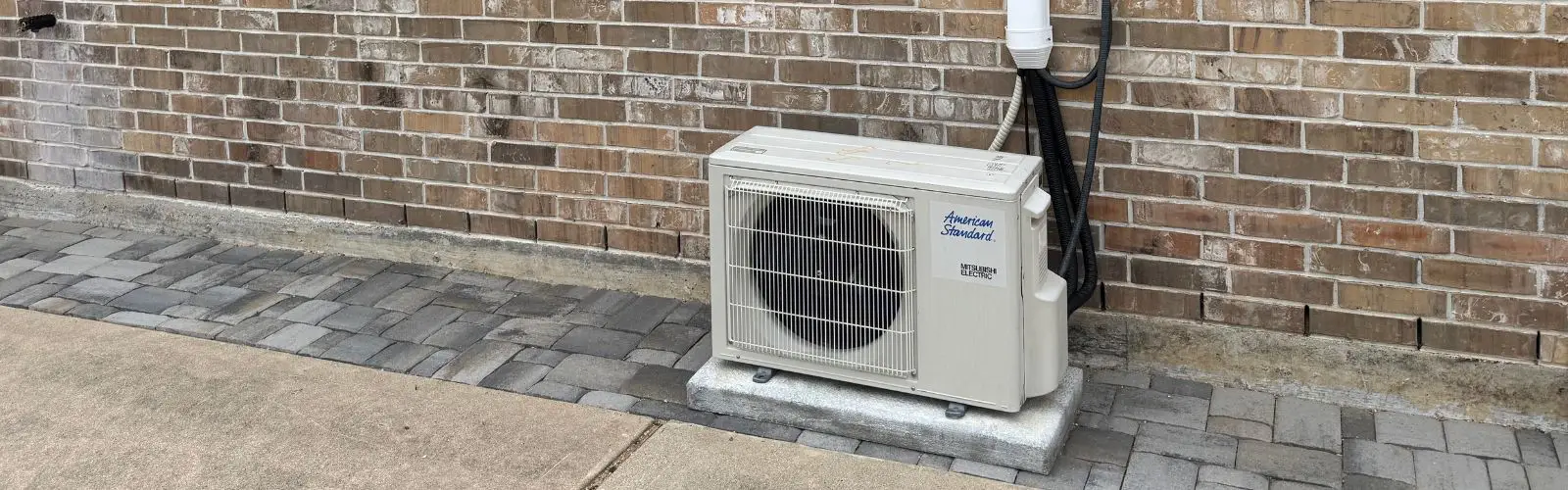
Two pieces. A small outdoor unit, roughly the size of a large suitcase, and an indoor head that delivers the air. They are joined by a line set that carries refrigerant, power and a condensate drain through a three-inch hole in the wall.
There is no ductwork, which is the whole point. Nothing is blowing air through a 140-degree attic and losing a share of it on the way. The indoor head sits in the room it is cooling.
It is a heat pump, so it works in both directions: cooling in summer, heating on the handful of genuinely cold days we get. If you are thinking about a heat pump for your whole house rather than a single room, that is a different conversation and it is covered on our heat pumps page.
When a mini split is the right answer in Houston
The garage or workshop
The most common request we get. A Houston garage in August is unusable, and it is almost never on the house’s duct system. A mini split makes it a room you can actually work in, and it is a far smaller job than extending ductwork out there.
The bonus room over the garage
Every builder in Fort Bend County puts a room above the garage, and it is always the hottest room in the house. It sits under the roof, above an uninsulated garage, at the far end of a duct run. A dedicated mini split fixes it properly rather than starving the rest of the house to feed it.
An addition, a sunroom or a converted porch
When you add square footage, the existing system was sized for the old house. Tying the new space into the old ductwork often means neither the new room nor the old ones are comfortable. A mini split serves the addition on its own.
The upstairs bedroom that has never been right
Heat rises, the duct run is longest, and closing vents downstairs does not fix it. Where rebalancing and duct repairs have not solved it, a mini split on that room will.
A home office you use all day
Running a whole-house system all day to keep one room comfortable is an expensive way to work from home. Conditioning just that room is not.
Houses with no ductwork at all
Older properties, garage apartments and casitas. Retrofitting ducts into a house that never had them is major work. Mini splits avoid it entirely.
The one nobody mentions: running on a generator
Houston loses power. Hurricane season, ice storms, and the ordinary summer thunderstorm that takes out a neighbourhood for a day.
A mini split draws far less power than a central system, which means a properly sized home standby generator can often keep one running when it could not carry the whole house. For a lot of families that is the difference between staying home and leaving: one room that stays cool and a working refrigerator.
If you already have a standby generator, or you are thinking about one, tell us when we quote. It changes which size and which model make sense.
Why they suit this climate specifically
Air conditioning in Houston is only half about temperature. The rest is moisture, and moisture is removed by a system running long, steady cycles rather than short blasts.
A central system that is oversized for the load cools the air fast, shuts off, and never runs long enough to pull much humidity out. You get a house that is cold and clammy. Most mini splits use inverter-driven compressors that throttle up and down to match the load instead of switching hard on and off, so they tend to run longer at lower output. That is exactly the behaviour that dehumidifies well.
The other half is ducts. A Houston attic reaches 140 degrees in summer, and every foot of duct running through it is losing capacity. A mini split has none.
What we will tell you honestly
Mini splits are not the answer to everything, and we would rather say so before you spend money.
| The consideration | The honest position |
|---|---|
| You can see the indoor unit | A wall-mounted head is visible. If that matters, there are ceiling cassettes and short-ducted versions that hide in a soffit or attic and only show a grille. They cost more. |
| It still makes water | Every mini split produces condensate and has a drain. That drain can block like any other. See clogged drain lines. |
| The filters need cleaning | Every few weeks in a dusty room, not once a season. They are easy to reach, but they do get neglected, and a fouled filter is the most common reason a mini split stops performing. |
| Your house already has good ductwork | Then a mini split is usually the wrong spend for whole-house comfort. Fix or replace the central system instead. We will say so. |
| Sizing matters more, not less | An oversized mini split short-cycles just like an oversized central system, and you lose the humidity control that made it attractive. This is why we look at the room rather than quoting from a floor area. |
| One head does not cool a whole house | Air goes where there is a path for it. A single head will not condition rooms around corners and behind closed doors. Multi-zone systems exist and we will lay out what yours would need. |
The options
Single-zone. One outdoor unit, one indoor head. The garage, the bonus room, the office. Simplest and most common.
Multi-zone. One outdoor unit serving several indoor heads, each with its own thermostat. Useful where two or three rooms need help and you would rather not put three condensers outside.
Wall-mounted heads. The familiar unit high on the wall. Most efficient use of the budget.
Ceiling cassettes. Recessed into the ceiling with a flush grille. Much less visually intrusive.
Short-ducted units. Hidden in a soffit or attic space and feeding one or two vents, so the room shows only a grille. This is the option people do not know exists, and it is often the answer when appearance is the objection.
We are an American Standard Customer Care Dealer and we also install Mitsubishi, and we service every make regardless of who fitted it.
How we quote one
| Step | What happens |
|---|---|
| 1. We come and look at the room | Size, ceiling height, insulation, windows, sun exposure, what is above and below it, and where the outdoor unit can sensibly sit. |
| 2. We check the electrical supply | A mini split needs its own circuit. In a garage or an older house this sometimes needs work, and you should know that before you decide, not after. |
| 3. We plan the line set and the drain | Where the hole goes, how the line set is routed and concealed, and where the condensate goes. A badly planned drain is a future callout. |
| 4. You get options in writing | Usually more than one, so you can see what the extra spend buys. No pressure and no same-day-only pricing. |
| 5. We commission it properly | Charge, airflow and temperature split measured and documented, so you know it is performing correctly on day one. |
Financing is available subject to approved credit.
We repair and service them too
Not only the ones we installed. Mini splits need a different service routine from a central system: the indoor head’s blower wheel and coil collect dust and biological growth in a way a ducted coil does not, and cleaning them properly is a specific job rather than something bolted onto a general tune-up.
If yours is running but not cooling the way it did, the usual suspects are a filter nobody has cleaned, a fouled indoor coil, a blocked condensate drain or a refrigerant leak in the line set. Our maintenance plan covers mini splits, and plan customers get 10% off any work.
Why Houston homeowners use us
- Family owned and working in southwest Houston since 1975
- Licensed under TACLA #00051749C, and insured
- NATE-certified technicians
- American Standard Customer Care Dealer, Mitsubishi installer, and we service all makes
- We look at the room before we quote, not the square footage
- 4.9 stars from 200 Google reviews
- We do not buy radio or television advertising, so that cost is not built into your quote
Areas we serve
Castle is based in Fulshear and installs mini splits across southwest Houston, Fort Bend County and the Bay Area.
Frequently asked questions
Will a mini split cool my garage in a Houston summer?
Yes, if it is sized for that garage rather than for its floor area. A garage has an uninsulated door, often no ceiling insulation, and a car that arrives radiating heat. We look at all of that before quoting, which is why we come and see it rather than giving a number over the phone.
Do mini splits heat as well as cool?
Yes. A mini split is a heat pump and reverses in winter. For the handful of genuinely cold days Houston gets, it handles a room comfortably without you running the whole-house heating.
Can a mini split run on a generator during a power outage?
Often, yes. A mini split draws considerably less power than a central system, so a properly sized home standby generator can frequently carry one when it could not carry whole-house air conditioning. Tell us if you have a generator or are planning one, because it affects which system we recommend.
How many rooms can one mini split cool?
One indoor head realistically conditions one open space. Air does not travel around corners and through closed doors. If you need two or three rooms, a multi-zone system with a head in each is the answer, running from one outdoor unit.
Do I have to have the unit on the wall?
No. Ceiling cassettes recess into the ceiling with a flush grille, and short-ducted units hide in a soffit or attic and show only a vent. Both cost more than a wall head, and both are worth asking about if appearance is your main objection.
How often do mini splits need servicing?
Annually by a technician, and the filters need cleaning far more often than that, every few weeks in a dusty space. The indoor coil and blower wheel also need proper cleaning, which is a different job from a standard tune-up and the most commonly skipped part of owning one.
Are mini splits noisy?
The indoor head is quiet, quieter than the air rushing through the vents of a central system. The outdoor unit is small and runs at low speed most of the time because the compressor modulates rather than cycling hard on and off.
Should I replace my central system with mini splits?
Usually not, if your house already has ductwork in reasonable condition. Mini splits earn their money where ducts do not reach or do not work. If your central system is failing, compare it against replacing the central system first, and we will give you a straight answer about which makes sense for your house.
Heat Pumps for Houston Homes
How a whole-house heat pump differs from a single ductless unit, and when each one is the right spend.
Published by Castle Air Conditioning & Heating. Family owned since 1975. Licensed TACLA #00051749C. NATE-certified technicians serving Houston, Fort Bend County and the Bay Area. Quotes in writing before work begins. Last reviewed September 2026.
One room that never gets comfortable? Call or text (713) 667-7606.