
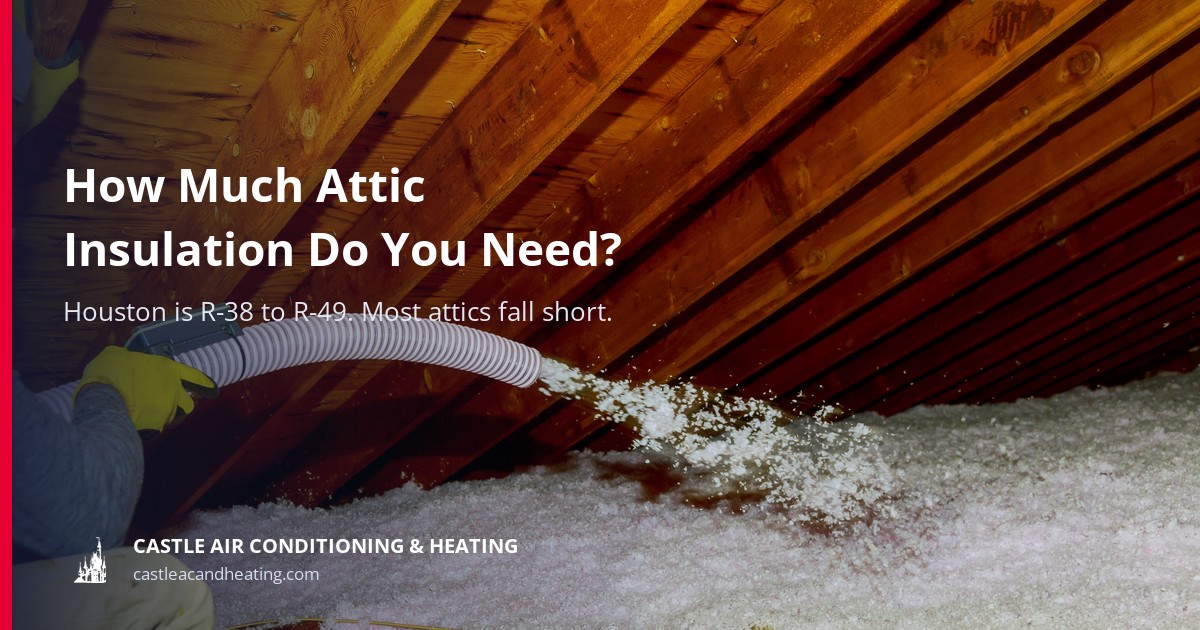
What attic insulation costs in Houston comes down to four things: the size of the attic floor, what’s up there now, whether any of it has to come out, and the R-value you’re going up to. ENERGY STAR puts a Houston attic at R-49 if it’s bare, or R-38 if you already have three or four inches. Most attics we open here are well short of that. You can check yours with a tape measure in about five minutes. Call or text (713) 667-7606.
On this page
How much insulation a Houston attic needs
Insulation is measured in something called R-value. It’s a score for how well a material blocks heat. The higher the number, the better it blocks. That’s the whole idea, and it’s all you need to follow the rest of this page.
How much you need depends on where you live. A house in Ohio needs more than a house here, because it’s fighting a different problem. Houston is in what the government calls climate zone 2, the hot and humid part of the country, so general advice you read online often doesn’t apply to us.
For a house that’s already built, ENERGY STAR recommends this:
| What’s in your attic now | What to insulate to | Roughly how deep that is |
|---|---|---|
| Nothing, or close to it | R-49 | About 15 to 17 inches |
| Three or four inches already | R-38 | About 13 to 14 inches |
Treat those inches as a close guide rather than an exact figure, because different materials take up different amounts of room for the same R-value. ENERGY STAR puts the southern minimum at R-38, or about 13 to 14 inches.
One thing worth knowing: loose insulation settles in its first year. A good installer blows it in deeper than the target to allow for that, instead of stopping level with it.
The gap in a typical Houston attic
The top two bars are what we usually find when we measure a Houston attic. The bottom two are what ENERGY STAR says you should have. Most houses here are sitting at around half.
Getting a house from the second bar up to the third one is the job we do. Plenty of people assume they’re fine because there is insulation up there. Having some and having enough are two different things.
In Houston, attic insulation is mostly there to help in summer. It isn’t mainly about holding heat inside during winter. It’s about stopping the heat in your attic from coming down through the ceiling while your air conditioner runs all afternoon. On a 100-degree day the air in your attic can be much hotter than the air outside. That heat has to go somewhere, and if there isn’t enough insulation in the way, a lot of it comes down into your rooms.
How to check what you already have
This takes five minutes and a tape measure. Open the attic hatch, put the tape straight down into the insulation somewhere away from the hatch, and read the depth.
Two things tell you most of what you need to know:
- Can you see the wooden beams? Your attic floor is built on beams that run across it, usually about eight inches deep. If the insulation is level with the tops of them, or you can see them poking out, you don’t have enough. ENERGY STAR uses that same quick test.
- Multiply the depth by three. Most insulation gives you about R-3 for every inch of depth. So six inches is roughly R-18, and twelve inches is roughly R-36. It’s only an estimate, but it’s close enough to tell you whether you have a problem.
| What the tape says | Roughly | Where that leaves you |
|---|---|---|
| 3–5 inches | About R-9 to R-15 | Common in Houston houses built before the mid-1990s. Well short. |
| 6–9 inches | About R-18 to R-27 | Typical builder-grade from the 2000s, and typical of what we find settled. |
| 10–12 inches | About R-30 to R-36 | Close. Adding a few inches to reach R-38 is a small job. |
| 13 inches or more | R-38 and up | You’re at the recommended level. Check it’s even across the whole attic. |
Measure in a few different spots, not just next to the hatch. Anyone who has been up there running a cable or working on your system will have pushed insulation out of the way, and the thin spots are usually right where they knelt.
This is worth doing properly. A thin or bare spot over one bedroom will make that room hot even if the rest of the attic is fine. A good average across the whole attic is no help to the room that has nothing over it.
What drives the cost of attic insulation
We don’t publish a price for this, and anyone who quotes you one over the phone before seeing your attic is guessing. Here is what actually makes the price go up or down, starting with the things that matter most:
- How big the attic floor is. This is the biggest factor by far, and the easiest to guess at yourself. It’s roughly the size of the floor below it.
- How much has to be added. Topping up an attic that already has six inches is a smaller job than filling an empty attic from scratch.
- Whether the old insulation stays or goes. Most of the time it stays and we blow over it. It has to come out if it’s been wet, if there’s been a rodent problem, or if there’s been biological growth up there. Removal is a separate job with its own labor and disposal.
- Whether the attic gets air sealed first. That means closing up the gaps and holes before the insulation goes down. It’s extra work, and it’s almost always worth doing.
- Getting in and moving around. A walk-up attic is straightforward. Pull-down stairs in a hallway, a low-pitch roof you can’t stand up in, or a long carry from the only hatch all add time.
- Storage floors. If you keep boxes up there, there’s plywood laid over part of the attic. Insulation can’t go to full depth underneath it, so either you accept less in that area or the platform gets raised first.
- What else is in the way. Air ducts, recessed ceiling lights that need space around them, and bathroom fans that turn out to be blowing into the attic instead of outside. We’d rather point those out than bury them.
You get a price once someone has been up there and measured. You’ll get the options too, with the difference between them explained. If the cheaper option of blowing new insulation over the old one is the right call for your house, that’s what we’ll tell you.
Our blown-in attic insulation page walks through how the work is done.
Blown-in or batts
There are two ways to put insulation in an attic.
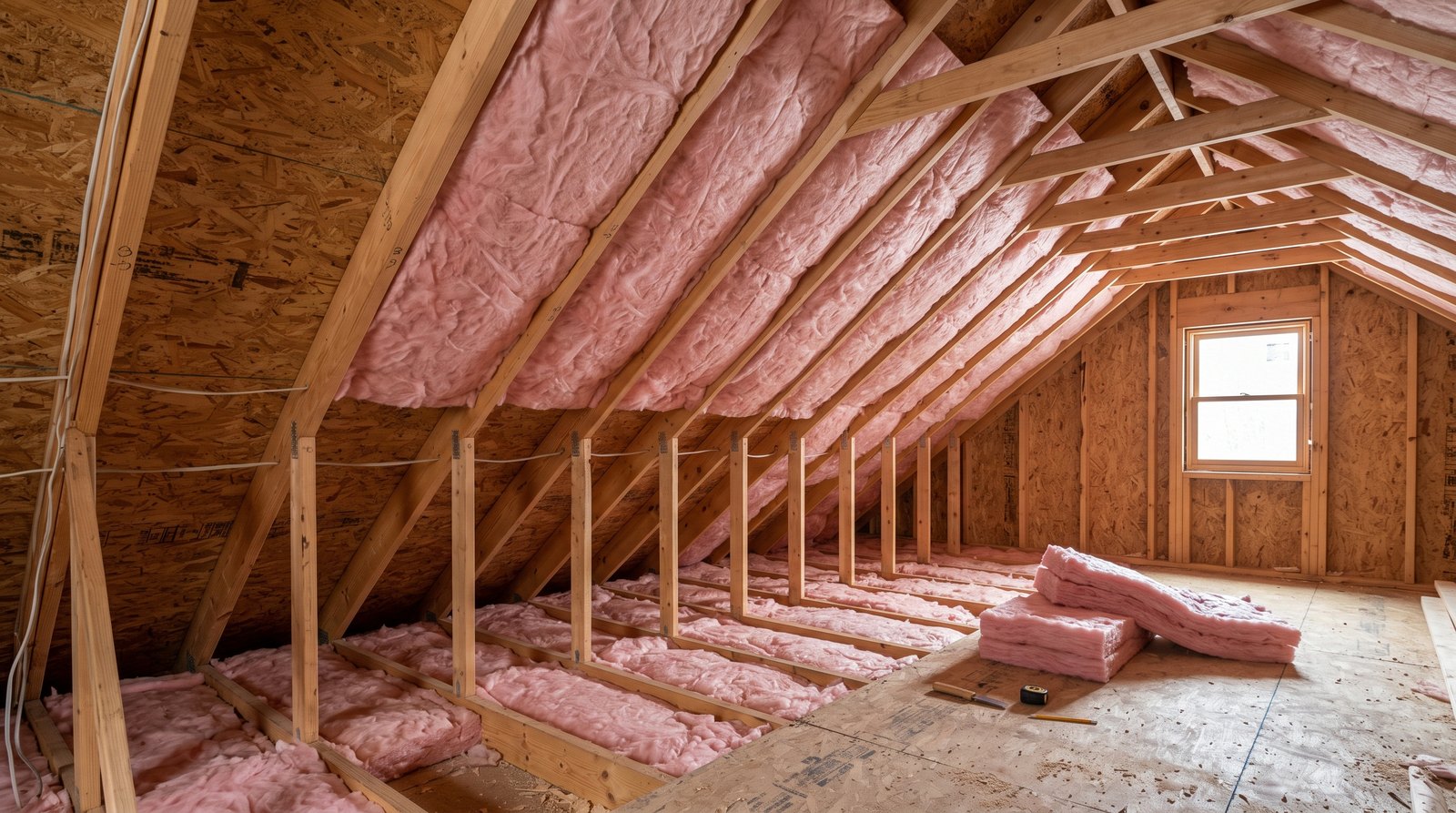
Batts are the rolls and blankets you’ve seen in a hardware store, usually pink or yellow. They come in fixed widths and get laid between the beams by hand. Blown-in is loose, fluffy material fed through a hose and sprayed in until it’s the right depth.
We use blown-in, and for an attic that’s already built it’s nearly always the better answer. The reason is simple: coverage.
Batts are rectangles. An attic floor isn’t. Every beam, brace, wire and air duct is something a batt has to be cut around, and every one of those cuts leaves a gap where heat can get through.
Blown-in insulation doesn’t have that problem, because it goes in loose and fills in around everything. It also gets into the low corners where the roof slopes down to meet the outside wall. Those corners are hard to reach, and they sit directly above the rooms at the edges of your house, which are usually the ones that get too hot.
Batts still make sense in a few places, mostly new construction and open framing where you can lay them properly. On a retrofit over existing insulation in a 1990s Katy or Fulshear attic, blown-in wins.
Air sealing, the part that gets skipped
Air sealing just means closing up the holes between your house and the attic before the insulation goes down.
It matters because insulation and air leaks are two different problems. Insulation slows down heat moving through your ceiling. It does almost nothing to stop hot air pouring through an open gap. The good news is that sealing the gaps is usually the cheaper of the two jobs.
The ones worth finding are the ones you can’t see from inside the house:
- Gaps where the tops of your interior walls meet the attic floor
- The housings around recessed ceiling lights
- The boxed-in space above the furnace or air handler
- Holes where pipes and wiring pass through the ceiling
- The attic hatch itself, which is often a bare sheet of plywood with nothing on it at all
ENERGY STAR estimates that sealing the gaps and adding insulation together save a household in the southern part of the country about 6% of the total utility bill, and about 9% of heating and cooling.
The order matters. If sixteen inches of insulation goes down over an attic floor that was never sealed, those gaps are still open underneath it, and now nobody can get to them.
What new insulation won’t fix
People often add insulation hoping it will fix a problem that was never about insulation. Before you spend the money, here are the things it won’t solve:
- Leaking or undersized ducts. If cooled air is escaping into the attic on the way to the bedroom, more insulation above the ceiling doesn’t put it back. This is the single most common cause we find when upstairs won’t keep up, and insulation is only one of six reasons on that list.
- An air conditioner that’s too small or wearing out. Insulation means your system has less work to do. It doesn’t make a tired or undersized system any more powerful than it already is.
- A damp attic. If there’s moisture up there, find out where it’s coming from first. Wet insulation stops working, and covering a leak over doesn’t fix the leak.
- A bathroom fan blowing into the attic. This is more common than you’d think. The fix is to redirect the fan outside, not to insulate over it.
If you’re not sure which of these you’ve got, it’s worth having someone come and look rather than guessing. An hour in the attic often saves people from paying for the wrong fix.
Why fall and winter are the best time
You can have attic insulation put in at any time of year, and if your attic is bare and your bills are high, there’s no sense waiting. But if you’ve got a choice about when to do it, the cool months are the better time, and it’s worth knowing why.
The first reason is simple. The air in a Houston attic in summer is far hotter than the air outside, and this job takes a crew several hours in full protective gear working a hose and a blower. The work goes faster and more comfortably in November than it does in August.
The second reason matters more to you. Attic insulation helps you most during the summer, so you want it already in place before the heat arrives, rather than partway through it. Have it done in November or January and it’s working for you from the first hot week. Leave it until June and you’ve already paid for half a summer you didn’t need to.
There’s also the calendar. In the cool months we have more room to schedule you at a time that suits you. By mid-summer we’re fitting insulation around emergency repair calls, so the wait is usually longer.
It helps a little in winter too. Houston only gets a handful of genuinely cold weeks, but on those nights heat escapes up through your ceiling, the same way heat comes down through it in July. Your heater then has to run longer to make up for what’s being lost.

When an attic is workable, by month
Normal average high temperature for Houston, 1991 to 2020 climate normals from the National Weather Service record for Houston. Green months are the comfortable ones to do this work in. Amber months are hot. Red months are the ones where an attic is a punishing place to spend a day, so the work goes slower.
Seven months are comfortable, two are hot, and three are brutal. If you’re planning ahead rather than reacting to a problem, the easy stretch runs from October through April.
Frequently asked questions
How much does attic insulation cost in Houston?
It depends on how big your attic is, how much insulation is already up there, whether any of it has to be taken out, and how much you want added. Removing old insulation, a hard-to-reach attic, and plywood storage floors that have to be worked around all push the price up. We give you a figure after someone has looked at the attic and measured it, with your options explained, rather than a number over the phone before anyone has seen it.
How much attic insulation do I need in Houston?
Houston is in climate zone 2. ENERGY STAR recommends R-49 for an attic with little or no insulation, and R-38 if you already have three or four inches. In depth terms that’s roughly 15 to 17 inches for R-49 and 13 to 14 inches for R-38, depending on the material.
How many inches of insulation should be in my attic?
About 13 to 14 inches gets you to R-38, which ENERGY STAR gives as the southern minimum. Reaching R-49 means roughly 15 to 17 inches. The quick check is the wooden beams that run across your attic floor. If you can see the tops of them, there isn’t enough up there.
Do I have to remove the old insulation first?
Usually no. Most of the time we blow new material straight over what’s there, which is both cheaper and faster. It has to come out if it’s been wet, if rodents have been in it, or if there’s biological growth. In those cases removal is its own job and we’ll say so before starting.
Is blown-in insulation better than batts?
For an attic that’s already built, nearly always. Batts have to be cut around every beam, wire and duct, and each of those cuts leaves a gap. Blown-in insulation fills in around everything, and it reaches the low corners where the roof slopes down to meet the outside wall. Batts work better in new construction, while the framing is still open.
Will adding attic insulation lower my electric bill?
It should, though be careful with the savings numbers you see online. ENERGY STAR estimates that sealing the gaps and adding insulation together save a household in the southern part of the country about 6% of the total utility bill, and about 9% of heating and cooling costs. You’ll save more if you’re starting with very little insulation, and more again if the gaps get sealed at the same time.
Does attic insulation help in summer, or only winter?
Summer, mostly. On a July afternoon the air in a Houston attic gets far hotter than the air outside. That heat pushes down through your ceiling and into the rooms your air conditioner is trying to cool. The insulation is what sits in between and slows it down.
When is the best time of year to do it?
Fall, winter or spring, if you have the choice. A Houston attic is a hard place to work in July, and booking in the cool months also means the insulation is in place before summer, which is when it helps you most. That said, we’ll come out in summer if that’s when you need us. If you’re not sure whether you need it at all, we can take a look at your attic on your next maintenance visit.
Getting it measured
If the tape measure said something under ten inches, it’s worth having someone look. We cover Houston, Fort Bend County, the Bay Area and the Gulf Coast. We install blown-in attic insulation, and we service the heating and cooling equipment in your attic as well.
Call or text (713) 667-7606, or book an appointment online.
Real homeowners, real service
Houston homeowners keep asking for our technicians by name.
Google Reviews
4.9
★★★★★
Based on 201 reviews
Why Is Upstairs Hotter Than Downstairs? — thin insulation is one of six reasons an upstairs room won’t cool down, and it’s rarely the first one we find. That page goes through all six, in the order we check them. If you want to know what a service visit covers, preventative maintenance explains that.
Not sure what’s above your ceiling? We’ll measure it and tell you honestly whether it’s worth adding to.
