QUICK ANSWER
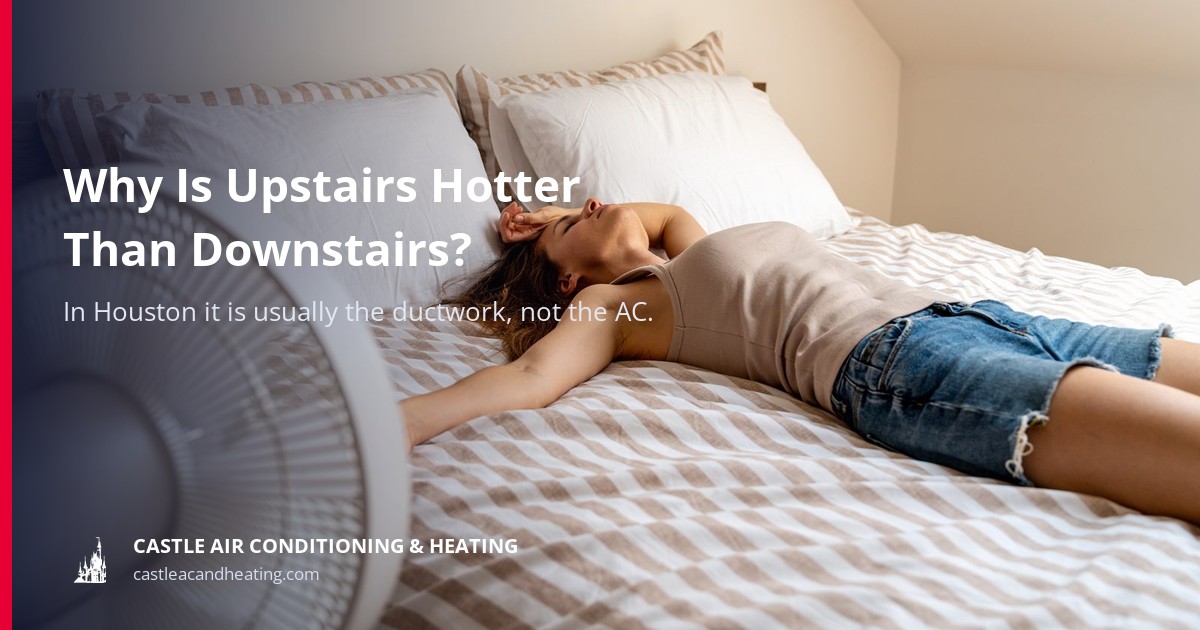
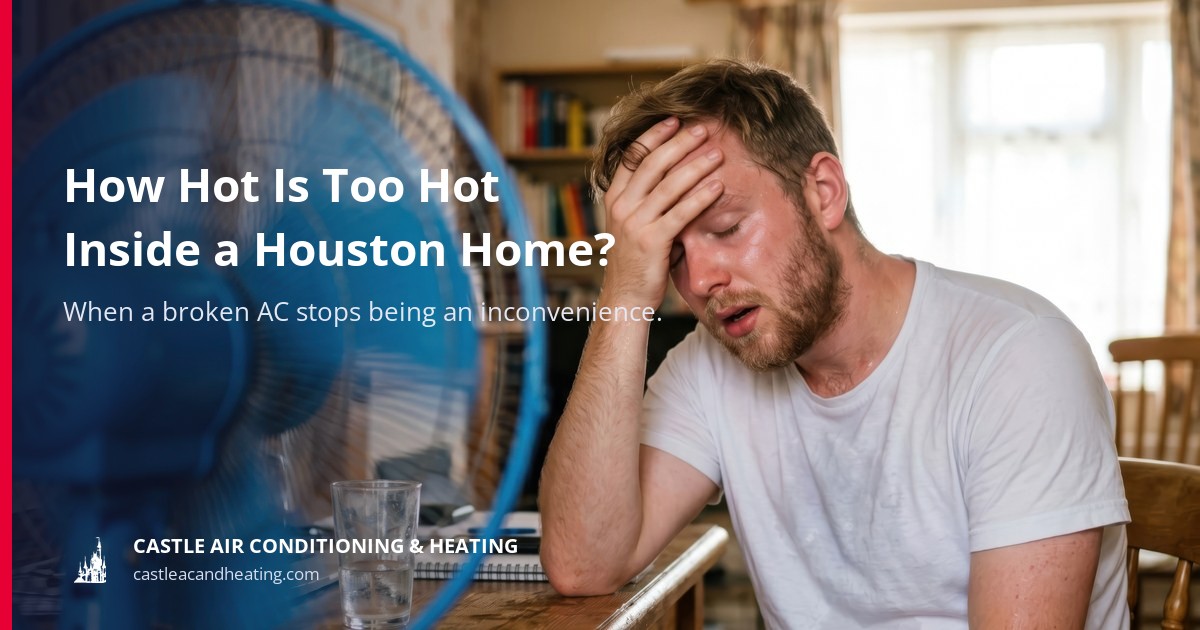
Inside a Houston house, the number that matters is not the one on the thermostat. It is the heat index, because humidity is what stops your body cooling itself. At 90 degrees indoors with the humidity we normally carry, the air can feel like 106 to 113. Above 90 degrees indoors the CDC says a fan can make you hotter rather than cooler. If anyone in the house is over 65, under one year old, pregnant, or taking medication that affects temperature regulation, treat 90 degrees indoors as the point to stop waiting. Castle Air Conditioning & Heating can usually reach you the same day. Call or text (713) 667-7606.
If the air conditioning is off right now
Close the blinds on any window the sun is hitting, move everyone to the lowest floor, and drink water before you feel thirsty. Do not wait to see whether it gets better on its own. A Houston house with the cooling off does not level out at a comfortable temperature, it keeps climbing until the sun goes down.
On this page
Why the thermostat reading is the wrong number
Your body cools itself by sweating, and sweat only cools you when it evaporates. In dry air it evaporates fast. In humid air it does not evaporate much at all, so it sits on your skin and you keep the heat. That is why 90 degrees in Phoenix and 90 degrees in Houston are not remotely the same experience, and it is why the temperature on the wall tells you less than you think.
The measure that accounts for this is the heat index. It combines temperature and humidity into the temperature your body actually experiences. Here is what the National Weather Service formula returns for a house sitting at 90 degrees inside, at different humidity levels.
A house at 90°F inside, and what it actually feels like
Heat index at a fixed 90°F indoor temperature, by relative humidity. Houston summers commonly sit in the 60 to 80 percent range.
Calculated with the National Weather Service heat index formula. The room temperature never changes across those five bars. Only the humidity does.
That is the part people miss. Two houses can both read 90 on the thermostat and one of them is survivable for an afternoon while the other is not. In Houston, when the air conditioning stops, the humidity indoors climbs as well, because dehumidification was one of the things the system was quietly doing for you.
How hot is too hot inside
There is no single legal number, but the guidance converges on a few useful thresholds. This is the scale we use when someone calls and asks whether they should wait until morning.
78°
85°
90°
95°
Comfortable
Sleep suffers
Fans stop helping
Do not wait
Normal running range
Tolerable in daylight
CDC guidance
Risk climbs quickly
Indoor air temperature. Add humidity and the felt temperature is higher again.
Why a fan stops helping at 90 degrees
This is the one that surprises people, and it is worth knowing before you spend a night in a hot house with three box fans running.
The CDC’s guidance is specific: use fans, but only if indoor temperatures are below 90 degrees. Above that, moving hot air across your skin can raise your body temperature instead of lowering it. The National Weather Service says the same thing in its heat illness guidance, and puts the cutoff at a heat index in the high 90s.
A fan does not cool a room. It only helps by speeding up evaporation from your skin. Once the air is hotter than you are, and humid enough that evaporation has largely stopped, you have removed the only mechanism the fan was using. At that point it is a convection oven on a low setting.
So if it is 93 degrees in your living room and the fans are not touching it, that is not a sign you need more fans. It is a sign the fans have stopped being the answer.
Who gets into trouble first
A healthy adult can sit out an uncomfortable afternoon. Not everyone in the house is a healthy adult, and the difference is not small.
Infants under one year. They cannot regulate their temperature well, cannot move themselves somewhere cooler, and cannot tell you what is wrong.
Adults over 65. The body’s thirst signal and its ability to shed heat both weaken with age. People in this group frequently do not feel dangerously hot until they are.
Anyone pregnant, or with a heart or lung condition. Heat puts direct additional load on the cardiovascular system.
Anyone on medication that affects temperature regulation. This is the one people overlook entirely. Diuretics, beta blockers, some antihistamines and several psychiatric medications all interfere with sweating, circulation or fluid balance. The CDC’s advice is to talk to your doctor about a heat plan rather than stop taking anything.
Pets. Dogs cool themselves almost entirely by panting, which is an evaporative system, so humidity hits them the same way it hits you. Flat-faced breeds have the worst of it.
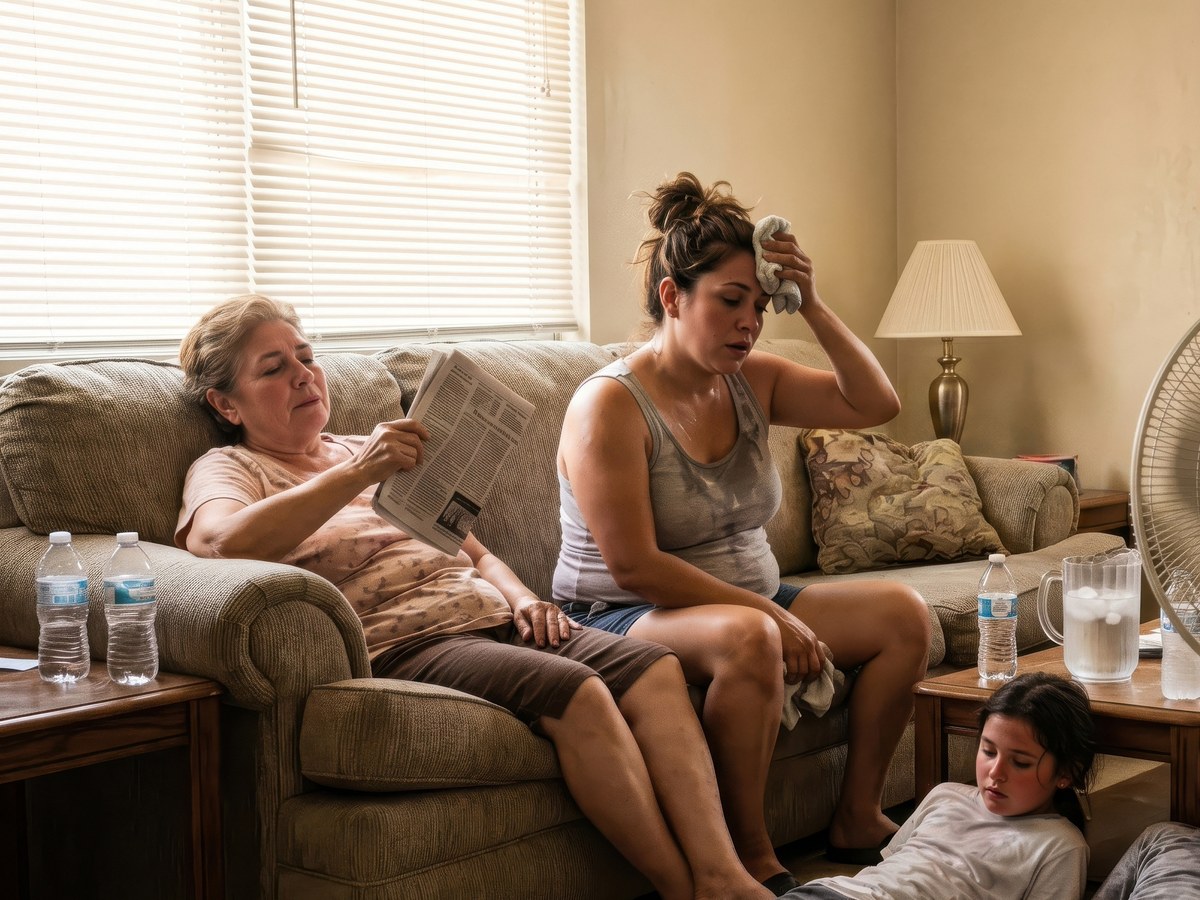
If one of those describes someone in your house, the thresholds above move down. Ninety degrees indoors is not a wait-and-see situation for a six-month-old.
The signs that mean stop waiting
Heat illness runs on a scale, and the top of that scale is a medical emergency rather than an air conditioning problem. These are the warning signs published by the National Weather Service and the CDC.
| What you are seeing | What it is | What to do |
|---|---|---|
| Painful muscle cramps and spasms, usually legs or abdomen, with heavy sweating | Heat cramps | Move somewhere cooler, sip water, rest. Get medical help if cramps last more than an hour. |
| Heavy sweating; weakness or tiredness; cool, pale, clammy skin; fast weak pulse; dizziness, nausea or headache; fainting | Heat exhaustion | Cooler room, loosen clothing, cool wet cloths, sips of water. Immediate medical help if they vomit, worsen, or it lasts more than an hour. |
| Throbbing headache; confusion or slurred speech; hot, red skin; body temperature above 103°F; rapid strong pulse; loss of consciousness | Heat stroke | Call 911 immediately. Move them somewhere cooler and cool them with wet cloths. Do not give fluids. |
The distinction that matters most: with heat exhaustion the skin is usually cool and clammy, and with heat stroke it is often hot and dry, and there is confusion. Confusion is the signal to stop assessing and call for help.
What to do while you wait
Assuming nobody is showing the signs above, and you are waiting on a technician, these are worth doing in roughly this order.
Shut the sun out. Close blinds and curtains on every window getting direct sun, particularly west-facing ones in the afternoon. This is the single biggest thing you can do to slow the climb.
Go downstairs. If you have two floors, the ground floor will be meaningfully cooler, for the same reasons we covered in why upstairs runs hotter than downstairs.
Stop making heat. The oven, the dryer and the dishwasher all dump heat and moisture into a house that currently has no way to remove either.
Drink before you are thirsty. Thirst lags behind dehydration, and it lags further the older you are.
Use water on skin rather than a fan alone. A cool shower, or a wet cloth on the neck and wrists, works when a fan has stopped working, because you are supplying the evaporation yourself.
Have somewhere to go. If the house is above 95 and someone in it is in one of the higher-risk groups, the right answer may be a few hours somewhere air conditioned rather than a heroic wait at home.
So is it an AC emergency?
That depends on who is in the house rather than on the equipment, which is the point of everything above. For the repair side of it, including what we treat as an after-hours call-out and what we would honestly tell you can wait until morning, see our emergency and same-day AC repair page.
If you call in the morning we can usually get to you the same day. Most of what takes a system down in September is a failed capacitor or contactor, and those are same-visit repairs. Our AC service and repair team covers Fulshear, Katy, Richmond, Sugar Land, Bellaire, the Heights, Seabrook and the wider Bay Area.
Frequently asked questions
How hot is too hot inside a house?
Below 85 degrees is uncomfortable but tolerable for a healthy adult. At 90 degrees the CDC says fans stop helping and can make you hotter. Above 95 degrees indoors, risk climbs quickly for everyone and is already serious for infants, adults over 65, pregnant women and anyone with a heart or lung condition. In Houston you also have to add humidity, which can push the felt temperature 15 to 20 degrees above the thermostat reading.
Will a fan keep me cool if the AC is broken?
Only up to a point. A fan does not cool air, it speeds up evaporation from your skin. Once indoor temperatures pass 90 degrees, or the heat index is in the high 90s, the CDC and National Weather Service both advise that a fan can raise your body temperature rather than lower it. Below that threshold a fan genuinely helps.
How fast does a Houston house heat up without air conditioning?
Faster than most people expect, and it does not level off at something comfortable. With the sun on the windows and no dehumidification, indoor temperature and humidity both climb through the afternoon and keep climbing until the sun goes down. A house that was at 75 in the morning can be in the 90s by late afternoon.
Is it safe to sleep in a house with no air conditioning in Houston?
For a healthy adult, one night in the mid 80s is unpleasant rather than dangerous, provided you are drinking water. It is a different question if the room is above 90, or if the person sleeping there is a baby, over 65, pregnant, or on medication that affects temperature regulation. In those cases, find somewhere cooler for the night.
What are the first signs of heat illness?
Heat cramps usually come first, then heat exhaustion: heavy sweating, weakness, cool and clammy skin, a fast weak pulse, dizziness, nausea or headache. Heat stroke is the emergency, and the giveaways are confusion or slurred speech, hot skin, and a body temperature above 103 degrees. Confusion means call 911 rather than keep waiting.
Does humidity really make that much difference indoors?
Yes, and it is the reason Houston is harder than a dry climate at the same temperature. At 90 degrees indoors with 40 percent humidity the heat index is 91. At the same 90 degrees with 80 percent humidity it is 113. The room temperature is identical. Only the humidity changed.
Can you get out the same day if my AC has stopped?
Usually yes, if you call in the morning. The honest exception is a day that is already full, and we would rather tell you that on the phone than leave you waiting on a technician who is not coming. Call or text (713) 667-7606.
One last thing worth saying plainly
Most of the calls we take in September are not emergencies in the medical sense. They are uncomfortable, and they get fixed the same day. The reason we wrote this is that a small number of them are genuinely urgent, and the deciding factor is almost never the equipment. It is who is sitting in the house while it gets hotter.
Real homeowners, real service
Houston homeowners keep asking for our technicians by name.
Google Reviews
4.9
★★★★★
Based on 200 reviews
We are based in Fulshear and cover southwest Houston, Fort Bend County, the Bay Area and the Gulf Coast.