
Clogged AC Drain Line: How to Clear It and When to Call
QUICK ANSWER
Turn the system off at the thermostat first. While it runs it keeps making water. A clogged condensate drain line is usually cleared by attaching a wet/dry vacuum to the outdoor end of the pipe for two or three minutes, then pouring a cup of distilled white vinegar into the access tee near the indoor unit. If water has already reached a ceiling, if the line is still blocked after vacuuming, or if the system will not restart, stop and call. Castle Air Conditioning & Heating answers 24/7 on (713) 667-7606.
Do this first
Switch the system off at the thermostat before anything else. An air conditioner pulls water out of the air the whole time it runs, so leaving it on while the drain is blocked simply adds to the problem.
Why your AC produces water at all
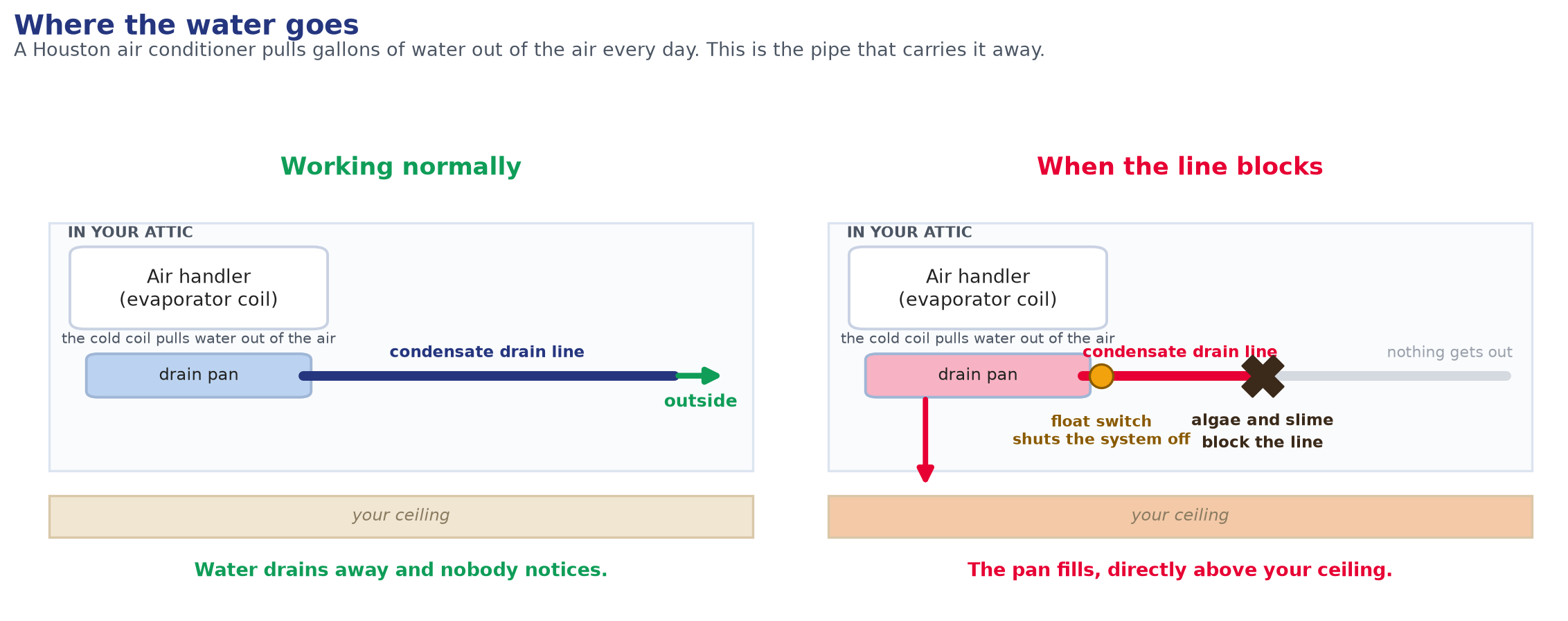
An air conditioner does two jobs: it lowers the temperature of the air, and it takes moisture out of it. On the Gulf Coast a large share of the work is the second one, and all that moisture has to go somewhere.
It condenses on the cold evaporator coil, drips into a drain pan underneath, and runs out of the house through a narrow PVC pipe called the condensate drain line. On a humid Houston day a single system can produce several gallons.
Why the line blocks
That pipe is dark, permanently damp and slightly warm. It is close to ideal conditions for algae and biofilm, which build up on the inside wall over a season until the pipe closes up. Dust pulled through the system and anything that gets past the filter adds to it.
This is why it happens more here than in drier parts of the country. Houston’s humidity means more condensate moving through that line for more months of the year, so there is more to feed the growth and more water backing up when it blocks.
Signs your drain line is clogged
| What you notice | What it usually means |
|---|---|
| The system shut itself off and will not restart | The float switch has done its job. It detected a full pan and cut the system before the water reached your ceiling. |
| Water stains or a brown ring on a ceiling | The pan has already overflowed. Turn the system off and call rather than working on it yourself. |
| Water around the indoor unit or in the attic | The pan is overflowing, or the line has come apart at a joint. |
| Standing water in the drain pan | The line is blocked or has lost its fall. It should never hold water. |
| A steady drip from a pipe outside, often above a window | That is the secondary drain line. It only ever runs when the main one has failed, so it is a warning, not a normal sight. |
| A musty smell when the system starts | Biological growth in the pan or on the coil, which usually travels with a drainage problem. |
| The house feels damp even though it is cool | Moisture is not leaving the system properly. |
How to clear a clogged AC drain line
Most blockages clear in under half an hour with a wet/dry vacuum. Work through these in order.
1. Turn the system off. At the thermostat, and at the breaker if you are going to be working near the air handler.
2. Find the two ends of the line. Indoors, look for a PVC pipe leaving the air handler, usually with a capped vertical fitting a few inches along. That cap is the access tee. Outdoors, the same line exits through a wall, often near the condenser or above a flower bed.
3. Deal with any standing water. If the pan is full, get the water out first with a wet/dry vacuum or towels. Emptying the pan is often what allows the float switch to reset.
4. Vacuum the line from outside. This is the step that actually clears it. Hold the wet/dry vacuum hose over the open end of the pipe outdoors, seal the gap with a rag or your hand, and run it for two to three minutes. You will usually hear the blockage give, and you will often pull out a slug of dark sludge.
5. Flush the line from inside. Take the cap off the access tee and pour in about a cup of distilled white vinegar. Leave it half an hour, then follow with water and watch that it runs freely out of the outdoor end.
6. Replace the cap and restart. Put the cap back on, switch the system on and check the line is draining. Keep an eye on it over the next day.
A note on bleach
Bleach works, but it can damage some drain pans and fittings, and manufacturers differ on whether they will accept it. Ask us before putting bleach into your system. Distilled white vinegar does the job on routine buildup without the argument.
Do not blow compressed air into the line either. It can push a solid blockage further in, or separate a glued joint inside the attic where you cannot see it.
When to stop and call someone
- Water has already reached a ceiling or a wall. That is active damage and it is an emergency, not a maintenance job. See emergency AC repair.
- You cannot find the access tee or the outdoor end. Some installations are genuinely awkward, particularly in older homes.
- The line is still blocked after vacuuming. A blockage that will not shift usually means a problem further along, such as a sagging run or a failed joint.
- The system will not restart once the pan is empty. The float switch may have failed rather than tripped.
- It keeps happening. A line that clogs two or three times a season is telling you something about how it was installed, not about how often you clean it.
- The air handler is somewhere you should not be climbing. No blocked drain is worth a fall through a ceiling.
How to stop it happening again
Through the cooling season, pour a cup of distilled white vinegar into the access tee once a month. It takes two minutes and it keeps the growth down before it becomes a blockage. Change your filter on schedule as well, because less dust through the system means less of it ending up in the pan.
Beyond that, the drain line is one of the things checked and treated on a professional maintenance visit, along with the float switch that is supposed to catch a blockage before your ceiling does. Our Houston maintenance schedule sets out what to do month by month, and our maintenance plan handles the timing for you.
Frequently asked questions
Why does my AC drain line keep clogging?
Because it is dark, damp and warm, which suits algae and biofilm. Houston’s humidity means a great deal of condensate moves through that line for most of the year, so buildup happens faster here than in drier climates. Flushing it monthly with distilled white vinegar through the cooling season is what keeps it clear.
Can I clear a clogged AC drain line myself?
Usually, yes. A wet/dry vacuum held against the outdoor end of the pipe for two or three minutes clears most blockages, followed by a vinegar flush through the access tee indoors. Stop and call if water has reached a ceiling, if the line will not clear, or if the system will not restart afterwards.
My AC turned itself off. Is that the drain?
Often, yes. A float switch is fitted to detect a full drain pan and shut the system down before water can reach your ceiling. If your air conditioner has stopped for no obvious reason on a humid day, the drain is one of the first things worth checking.
Should I use bleach in my AC drain line?
Ask first. Bleach clears growth effectively but can damage certain drain pans and fittings, and manufacturers take different positions on it. Distilled white vinegar handles routine buildup without that risk, which is what we generally recommend.
How much water should my AC produce?
More than most people expect. On a humid Houston day a single residential system can pull several gallons out of the air, which is precisely why a blocked line becomes a problem so quickly.
There is water dripping from a pipe above my window. Is that normal?
No. That is almost certainly the secondary or emergency drain line, and it only runs when the primary line has failed. It is doing its job by putting the water outside rather than inside, but it is a signal that the main drain needs attention now.
How often should the drain line be cleaned?
A monthly vinegar flush through the cooling season for a homeowner, plus a professional clean and treatment at the annual cooling service. Commercial equipment runs longer hours and we recommend quarterly attention.
Does a clogged drain line damage the air conditioner?
The blockage itself usually does not harm the equipment, because the float switch should shut it down first. The damage is to the building, and it can be considerable if the air handler is in the attic and the switch does not work.
Your Houston HVAC Maintenance Schedule
What to check and when, and why humidity makes Houston systems different from the same equipment further north.
Areas we serve
Castle is based in Fulshear and covers southwest Houston, Fort Bend County and the Bay Area.
Published by Castle Air Conditioning & Heating. Licensed TACLA #00051749C. NATE-certified technicians serving Houston, Fort Bend County and the Bay Area. Quotes in writing before work begins. Last reviewed September 2026.
Water where it should not be? Call or text (713) 667-7606.