
Your Houston HVAC Maintenance Schedule
QUICK ANSWER
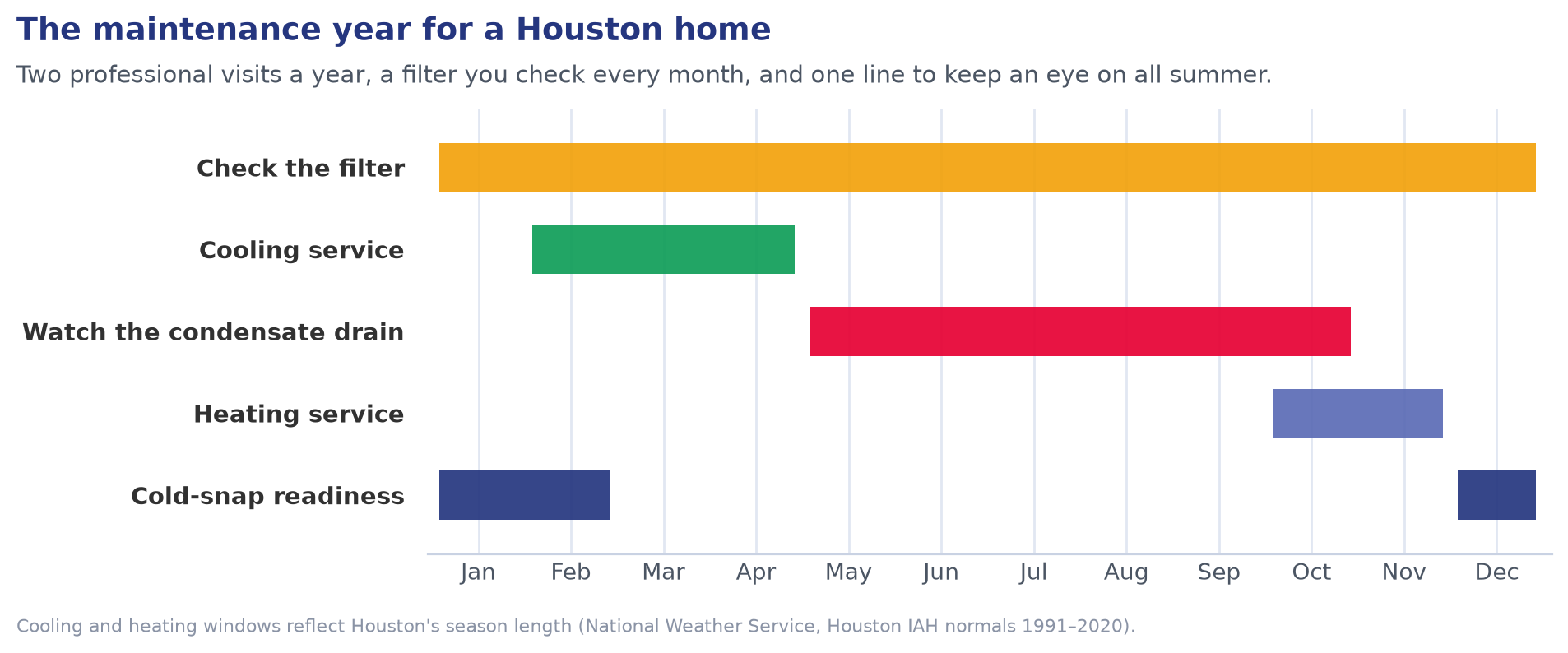
Castle Air Conditioning & Heating recommends professional service twice a year for a home system in the Houston climate — cooling in late winter or early spring, heating in the fall — plus a filter you check every month and a condensate drain you keep an eye on all summer. Commercial equipment needs attention quarterly. What makes Houston different is not the heat on its own. It is the moisture. Your air conditioner spends much of its working life pulling water out of the air, and most of the summer calls we take start with where that water ended up.
The short version
- Twice a year for a home system: cooling service February to April, heating service October to November.
- Every month: check the air filter, and from May through October flush the condensate drain with distilled white vinegar.
- Quarterly for commercial equipment, which runs longer hours and moves far more air.
- The Houston-specific risk is the condensate drain. Most air handlers here sit in the attic, directly above a ceiling, so a blocked drain becomes water damage rather than a puddle.
On this page
- Why a Houston system works harder than the thermostat suggests
- The schedule, month by month
- What gets done, and how often
- The condensate drain, and why Houston systems back up
- Cold but clammy: when humidity is the real problem
- What you can do, and what needs a technician
- How the schedule shifts across the Houston area
- Commercial systems run to a different schedule
- Frequently asked questions
Why a Houston system works harder than the thermostat suggests
An air conditioner does two jobs at once. It lowers the temperature of the air, and it takes moisture out of it. In a dry climate almost all of the work is the first job. On the Gulf Coast a large share of it is the second.
That has three consequences, and between them they explain nearly everything on this page. The system runs for longer to reach the same temperature. It produces a great deal of condensed water while it does so. And it spends months at a time with a cold, wet coil sitting in a warm, humid space — which is exactly the condition that lets things grow where you would rather they did not.
It also runs for far more of the year than most people assume. Houston’s average daily high sits at or above 80 degrees from April through October. A system here does not get a quiet season in the way one further north does, so the two service visits are less about ceremony and more about catching wear before the system is asked to run flat out.
The figures behind that: Houston’s average daily high is 92°F in June, 94°F in July and 95°F in August, and the average overnight low in July and August is roughly 76°F — warmer than most people set their thermostat. A house here gets no real overnight recovery in high summer, which is why a system that is already struggling never catches up. Those are National Weather Service climate normals for Houston Intercontinental, 1991–2020.
The schedule, month by month
Every month: check the filter
A blocked filter starves the system of airflow. That makes the coil colder than it should be, which makes it more likely to ice up, which stops the system cooling at all. It is the cheapest thing on this list and the one most often skipped.
Check it monthly. A basic one-inch filter usually needs replacing every one to three months. Pets, building work nearby or a lot of dust will shorten that. Thicker media filters last longer, but they still need looking at.
Late winter to early spring: the cooling service
Book this before the first properly hot week, not during it. February through April is the sensible window. Our seven checks to get an AC ready for Houston heat covers what to look at before the season starts. A technician will check refrigerant charge, clean the coils, test the capacitor and contactor, clear and treat the condensate drain, check the float switch, measure the temperature split across the coil and confirm the system is actually removing moisture rather than just moving cold air around.
The point of doing it early is simple. A weak capacitor found in March is a small part fitted at your convenience. The same capacitor found in July is a hot house, a wait, and sometimes a compressor that has been damaged in the meantime. If yours has already failed, that is an AC repair rather than a maintenance visit.
May through October: watch the condensate drain
This is the Houston-specific one, and it has its own section below because it causes more avoidable damage here than anything else we see.
Fall: the heating service
October and November. Houston winters are short, which is exactly why heating gets neglected until the first hard cold snap — at which point every house in the city wants a technician on the same morning. A heating check covers the heat exchanger, burners or heat strips, the flue, safety controls and the thermostat changeover.
If your home runs a heat pump or a package unit, the heating and the cooling share the same equipment, so the two visits are checking overlapping parts. That is not duplication. It is the reason a fault caught in October does not become a failure in January.
December through February: cold-snap readiness
Houston gets a handful of genuinely cold nights and they tend to arrive suddenly. Know where your emergency heat setting is, keep the outdoor unit clear, and if the system has not run for heat since last winter, run it for twenty minutes on a mild day rather than discovering the problem at eleven at night in a hard freeze.
What gets done, and how often
| Task | How often | Who does it |
|---|---|---|
| Check and change the air filter | Monthly check, replace every 1–3 months | You |
| Keep the outdoor unit clear | Through the year | You |
| Flush the condensate drain line | Monthly through summer | You, or us |
| Full cooling service | Once a year, late winter to spring | Us |
| Full heating service | Once a year, fall | Us |
| Coil cleaning | Annually, more often on coastal properties | Us |
| Refrigerant charge check | Annually | Us |
| Drain pan and float switch test | Annually | Us |
| Duct and airflow inspection | As needed | Us |
The condensate drain, and why Houston systems back up
When your air conditioner removes moisture from the air, that water has to go somewhere. It collects in a drain pan under the indoor coil and runs out through a narrow PVC line. On a humid Houston day a single system can produce several gallons.
That line is dark, permanently damp and slightly warm. Algae and slime build up inside it over a season, and eventually it blocks. The pan then fills, and where the water goes next depends entirely on how your home was built.
Most Houston homes have the air handler in the attic. That means the water is directly above your ceiling. A blocked drain is the reason for the brown ring on a bedroom ceiling, and it is the single most common summer call we take. A secondary drain pan and a float switch are meant to catch it — the float switch shuts the system off before the water reaches your ceiling — but only if the switch is working, which is one of the things a service visit tests.
What you can do about it
Through the summer, pour about a cup of distilled white vinegar into the access tee on the drain line once a month. It keeps the growth down and takes a couple of minutes. If it has already blocked, here is how to clear a clogged AC drain line step by step.
Ask us before using bleach. It works, but it can damage some pans and fittings, and the manufacturer’s guidance for your equipment matters more than a general rule.
If the system has already shut itself off, or there is water where it should not be, turn the system off at the thermostat and call. Running it keeps producing water. Water coming through a ceiling counts as an emergency.
Cold but clammy: when humidity is the real problem
A house can sit at 72 degrees and still feel unpleasant. If the air feels heavy, windows fog, floors feel tacky or there is a musty smell when the system starts up, the temperature is being handled and the moisture is not.
There are a few usual causes. An oversized system cools the air quickly, satisfies the thermostat and shuts off before it has run long enough to pull much water out — it short-cycles, and the house stays damp. A dirty coil or weak airflow has a similar effect. And a system that is low on refrigerant often keeps producing cool air while doing very little dehumidifying.
Persistent damp indoor air also gives biological growth somewhere to establish, usually on the coil, in the drain pan or in the duct nearest the air handler. That is where the musty smell comes from. Keeping indoor humidity below roughly 50 percent is the practical target, and it is a maintenance question before it is an equipment question — a clean coil, a clear drain and correct airflow do most of the work.
If the moisture problem persists after the system has been serviced properly, the answer is usually a whole-home dehumidifier or a change to how the system runs, rather than a new air conditioner. Our indoor air quality options cover filtration, purification and humidity control. We would rather tell you that than sell you a system you do not need.
What you can do, and what needs a technician
Worth doing yourself:
- Check and change the filter.
- Flush the condensate drain with vinegar monthly through summer.
- Keep two feet of clear space around the outdoor unit, and rinse leaves and grass clippings off the fins with a garden hose.
- Keep supply and return vents unblocked by furniture and rugs.
- Listen. New noises are information. A few more are in our spring home maintenance tips for Houston homeowners.
Leave to a licensed technician:
- Anything involving refrigerant. It is a licensed activity, and topping up a system that is low means finding the leak first.
- Electrical components. Capacitors hold a charge even with the power off.
- Cleaning the indoor evaporator coil.
- Anything involving the heat exchanger or gas burners.
- Duct sealing and airflow balancing.
How the schedule shifts across the Houston area
The bones of the schedule are the same everywhere we work. What changes is which part of it matters most, and that comes down to how and when the homes were built.
| Area | What we watch most closely |
|---|---|
| Fulshear and Cross Creek Ranch | Our home base. Newer master-planned homes with attic air handlers and long drain runs, so condensate is the main thing to stay ahead of. |
| Katy | A mix of newer builds and 1990s to 2000s systems now reaching end of life. Annual charge and capacitor checks matter more as equipment ages. |
| Sugar Land, Richmond and Missouri City | Directly adjacent to us. Largely the same pattern as Fulshear, with more variation in system age. |
| Bellaire, West University and Memorial | Older housing, tighter lots and harder attic access. Ductwork and airflow are more often the cause of a comfort complaint than the equipment is. |
| Houston Heights | Older homes where duct leakage and uneven cooling are common. Humidity control is usually an airflow problem here rather than a capacity one. |
| Pearland and Friendswood | Suburban stock of mixed age. Standard twice-yearly schedule, with attention to drain lines in attic installations. |
| Seabrook, Clear Lake, League City and Webster | Coastal air is hard on outdoor coils. Salt accelerates corrosion on the condenser, so coil cleaning and fin condition get checked more often here than inland. |
Wherever you are, the two service visits and the monthly filter check are the constant. The rest is a matter of emphasis.
Commercial systems run to a different schedule
Commercial equipment moves far more air, runs far longer hours and is usually harder to reach once something has gone wrong. We recommend quarterly maintenance on commercial systems rather than the twice a year we recommend for homes. Rooftop units in particular spend their whole lives exposed, and the cost of a failure is measured in lost trading hours rather than in comfort.
Frequently asked questions
How often should I service my air conditioner in Houston?
Twice a year for a home system — once for cooling before the season starts, once for heating in the fall — plus a filter you check monthly. Houston’s cooling season runs roughly April through October, so systems here accumulate more runtime than the same equipment would further north.
When is the best time of year to book maintenance?
Late winter or early spring for the cooling visit, and October or November for heating. Both are ahead of the rush. Booking a cooling service in July means competing for a slot with everyone whose system has already failed.
Why does my AC drain line keep clogging?
Because it is dark, damp and warm, which is ideal for algae and slime. Houston’s humidity means your system produces a lot of condensate, so there is plenty of water moving through that line all summer. Flushing it monthly with distilled vinegar keeps it clear.
My house is cool but it feels damp. What is wrong?
The system is handling temperature but not moisture. Common causes are a system that is oversized and short-cycling, a dirty coil, restricted airflow or low refrigerant. It is worth a diagnosis rather than guesswork, because the fixes are quite different.
There is a musty smell when the AC starts. What causes it?
Usually biological growth on the evaporator coil, in the drain pan or in the duct closest to the air handler, which is where condensation collects. It needs cleaning and the moisture source addressing. We will tell you what we find and what it needs. We are HVAC technicians rather than remediation contractors, so we describe what we can see and we will say so plainly if something is beyond our scope.
Do I really need two visits a year?
For a heat pump or package unit, where heating and cooling share the same equipment, we would say yes. For a system with a separate gas furnace, the cooling visit is the non-negotiable one in this climate, and the heating check is what stops a January surprise.
What happens if I skip maintenance for a year?
Usually nothing you notice immediately, which is the problem. Refrigerant drifts, capacitors weaken, coils foul and drains silt up gradually. The failure arrives later, on a hot day, as a bigger repair than it needed to be.
Does maintenance affect my warranty?
It can. Manufacturers generally expect equipment to have been maintained, and some require evidence of annual service before honoring a claim. Keeping records of your visits is worth doing for that reason alone.
Can I do the maintenance myself?
Some of it, and it genuinely helps — filters, the drain line, keeping the outdoor unit clear. Refrigerant, electrical components and anything involving gas need a licensed technician, both for safety and because diagnosing them properly needs instruments.
The Set It and Forget It Assurance Plan
If you would rather not have to remember any of this, our home maintenance plan pre-schedules both visits so they happen at the right time of year, reminds you automatically when one is due, and takes 10% off any work we do for you through the year.
Areas we serve
Castle is based in Fulshear and looks after homes and businesses across southwest Houston, Fort Bend County and the Bay Area.
Book your maintenance visit
Our home Set It and Forget It Assurance Plan pre-schedules both visits, reminds you when one is due, and takes 10% off any work we carry out for you during the year. Commercial agreements work differently: those are billed per visit rather than as a single up-front fee, and we recommend quarterly attention rather than twice a year.
The sensible move is to get the cooling service done before the season rather than during it. Call or text (713) 667-7606, or book your appointment online and pick a time that suits you.
Published by Castle Air Conditioning & Heating. Licensed TACLA #00051749C. NATE-certified technicians serving Houston, Fort Bend County and the Bay Area. Last reviewed September 2026.