
Why Is Upstairs Hotter Than Downstairs? A Houston Answer
QUICK ANSWER
A two to three degree difference between floors is normal. More than that is a fault, and in Houston it is usually the ductwork rather than the air conditioner. Supply ducts run through an attic that reaches 130 to 150 degrees in summer, so cooled air arrives upstairs already warmed, and any leak in those ducts dumps the rest into the attic before it reaches the room. Undersized returns and a single system serving both floors make it worse. Castle Air Conditioning & Heating can measure it and tell you which one it is on (713) 667-7606.
On this page
- How much of a difference is normal?
- Yes, heat rises — but that is not the whole answer
- Why Houston makes this so much worse
- The six things that actually cause it
- What you can try yourself
- What needs a technician
- When the answer is a mini split
- And if it really is the system
- Frequently asked questions
Try this first, tonight
Set your thermostat fan from AUTO to ON for a day. The blower keeps running between cooling cycles and mixes air between floors. If the gap narrows noticeably, your problem is distribution, not capacity — which is useful to know before anybody quotes you a new system.
Upstairs hotter than downstairs: how much is normal?
Two to three degrees warmer upstairs is ordinary and not worth fixing. Warm air rises, the upper floor sits under a hot roof, and no house is perfectly even.
Five degrees is a real complaint. Eight or ten degrees means something is genuinely wrong, and we see it constantly in two-storey homes across Katy, Fulshear, Richmond and Sugar Land — particularly in houses built from the 1980s through the early 2000s, before duct sealing was taken seriously.
What your temperature gap means
Measure the same time of day on both floors, away from vents and windows.
A gap this size almost never fixes itself, and it gets worse as duct materials age.
Yes, heat rises — but that is not the whole answer
Warm air is less dense than cool air. Heat it and the molecules spread further apart, so a given volume of it weighs slightly less and the cooler air around it slides underneath and pushes it up. That is buoyancy, and it is the same thing that lifts a hot air balloon. In a house it produces what engineers call stack effect: warm air drifts to the top of the building and leaks out through gaps around attic hatches, recessed lights and plumbing penetrations, while cooler air is drawn in lower down to replace it.
So the folk wisdom is right as far as it goes. It is just much smaller than people assume.
The reason is that your air conditioner overwhelms it. Air at 80 degrees is only around two per cent less dense than air at 70, so the force involved is gentle. A typical residential blower, meanwhile, is pushing somewhere near 1,200 cubic feet of air a minute through the house. Mechanical airflow on that scale swamps a slow natural drift.
In practice, stack effect accounts for roughly the two to three degrees we called normal above. It does not account for eight or ten. When the gap is that size, something is stopping cooled air from reaching the second floor at all — and in Houston that something is nearly always above your ceiling.
Why Houston makes this so much worse
In most Houston two-storey homes, the air handler and the supply ducts for the second floor sit in the attic. On a 98 degree afternoon that attic is running at 130 to 150 degrees.
So the system cools air to roughly 55 degrees, then pushes it through a long flexible duct lying in a space hotter than an oven set to warm. Even with the insulation intact, that air picks up heat the whole way. By the time it reaches the farthest upstairs bedroom it may be ten degrees warmer than it left.
Now add a leak. A disconnected boot, a torn inner liner, a strap that has cut through the insulation — and a share of the air you are paying to cool never arrives at all. It goes into the attic.
How hot the attic gets above your ceiling
Typical Houston attic temperatures on a sunny afternoon.
Indicative ranges, not measurements. The real figure for your house depends on roof colour, attic ventilation and how much insulation is left up there.
This is the single most common cause we find, and it is invisible from inside the house. Nothing in the room tells you it is happening. The thermostat downstairs is satisfied, so the system shuts off, and upstairs stays hot.
The six things that actually cause it
| Cause | How often we find it | What you might notice | Who puts it right |
|---|---|---|---|
| Leaking supply ducts in the attic | Most common | Weak airflow upstairs, high bills | Us |
| Not enough return air upstairs | Common | One small return, or none | Us |
| Duct runs too long, narrow or crushed | Common | The farthest room is always worst | Us |
| One system serving both floors | Common in older builds | System stops once downstairs is cool | Us |
| Attic insulation thinned or shifted | Occasional | Ceilings warm to the touch in the evening | Us |
| System undersized or failing | Least common | Both floors struggle, not just upstairs | Us |
1. Leaking supply ducts. Cooled air escaping into the attic before it reaches the room. Most common by a distance, and it gets worse every year as materials age.
2. Not enough return air upstairs. Many houses have plenty of supply vents on the second floor and one undersized return, or none at all. Air cannot be pushed into a room faster than it can leave. Without a return path the room pressurises slightly and airflow drops.
3. Duct runs that are too narrow, crushed or kinked. With the unit in the attic the upstairs runs are usually the short ones, so raw length is rarely the problem — restriction is. Flexible duct pinched behind a truss, bent hard around a corner, or left in a long sagging loop loses a surprising amount of airflow, and it is the rooms behind that duct that suffer.
4. One system trying to serve two floors. With a single thermostat, usually downstairs, the system stops as soon as the ground floor is comfortable. Upstairs never gets its share.
5. Attic insulation that has thinned or shifted. Blown-in insulation settles and gets disturbed by anyone working up there. Thin patches over upstairs ceilings radiate heat down all evening. We install blown-in attic insulation and see this constantly.
6. The system is genuinely undersized or failing. It happens, but it is further down the list than most people assume — and it is the most expensive conclusion to jump to. Check the first five first.
What you can try yourself
Run the fan continuously. As above. Costs a little more in electricity, mixes the air, and tells you something diagnostic.
Open every upstairs vent fully, and check them. People close vents in guest rooms and forget for years. Also put your hand over each one while the system runs — a vent producing noticeably less air than its neighbours is pointing at a duct problem behind it.
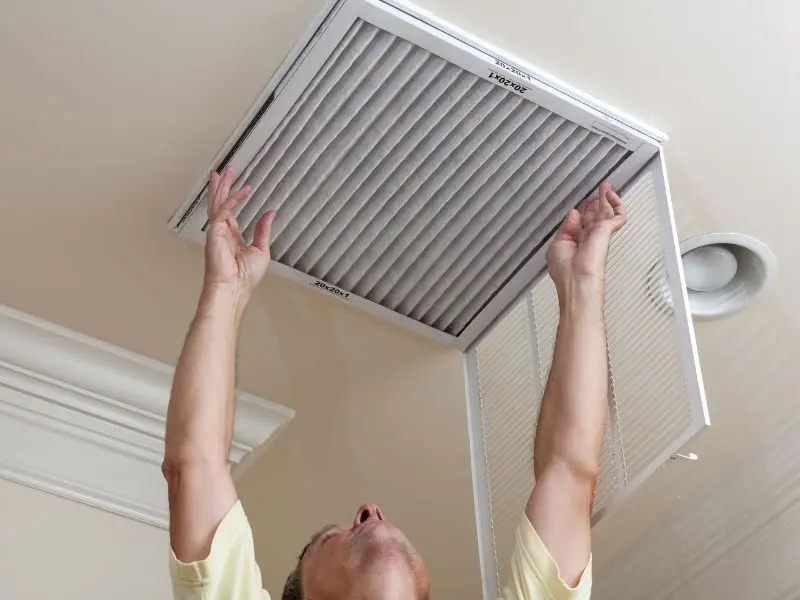
Change the filter. A loaded filter starves the whole system of air, and the rooms at the end of the longest runs lose out first. If you cannot remember the last change, that is your answer. Our Houston HVAC maintenance schedule sets out how often it actually needs doing here.
Close blinds on west-facing upstairs windows. Unglamorous and genuinely effective in the afternoon.
Do not close downstairs vents. This is the advice everyone gives and it is wrong. Closing vents raises pressure in the duct system, which increases leakage through every existing gap and strains the blower. It usually makes the imbalance worse, not better.
What needs a technician
Everything past that point requires measurement rather than guessing. What we do on this kind of call is take static pressure readings, measure airflow at the registers, check the temperature split across the coil, and get into the attic to look at the duct runs serving the rooms you are complaining about.
That tells us whether you need duct sealing and repair, a larger or additional return, balancing dampers, insulation, or something at the equipment. It is an hour or two of diagnosis that regularly saves people from replacing a system that was never the problem.
If you would rather start there, our AC service and repair team handles these diagnostics, and we offer same-day appointments across Houston and Fort Bend County.
When the answer is a mini split
Sometimes the room that is hot is a bonus room over the garage, a converted attic space, or an addition that was tied into ductwork never designed to reach it. Extending duct into those spaces often disappoints everyone.
In that situation a ductless mini split is frequently the better answer. It gives that one space its own capacity and its own thermostat, and it leaves the rest of the house alone. It is not the right fix for a whole second floor, but for one stubborn room it usually is.
And if it really is the system
If the equipment is fifteen years or older, struggling on both floors, and the ducts check out, then you are having a different conversation. Worth knowing before you do: new equipment on leaking or undersized duct will not deliver what it is rated for. Any honest proposal for AC installation and replacement should address the distribution as well as the box outside.
Frequently asked questions
How many degrees difference between floors is normal?
Two to three degrees is normal and not worth chasing. Five degrees is a genuine complaint. Eight to ten degrees means something is wrong — most often duct leakage in the attic or insufficient return air upstairs.
Should I close downstairs vents to push more air upstairs?
No. It is common advice and it backfires. Closing vents raises static pressure in the duct system, which forces more air out through every existing leak and makes the blower work harder. The upstairs rooms usually end up no better and the system ends up under more strain.
Will running the fan on ON instead of AUTO fix it?
It will not fix the underlying fault, but it genuinely helps by mixing air between floors, and it is a useful test. If continuous fan noticeably narrows the gap, your problem is distribution rather than a lack of cooling capacity. That points the diagnosis in a much cheaper direction.
Why is it so much worse in summer than in winter?
Because the attic is the cause. In July a Houston attic runs 130 to 150 degrees, so duct losses and ceiling heat gain are at their maximum. In winter the same house often feels reasonably even, which is why people assume the air conditioner is at fault rather than the ductwork.
Is zoning worth it for a two-storey house?
Sometimes. Zoning puts dampers and a second thermostat on the system so each floor calls for cooling independently. It works well when the ducts are in good condition and sized properly. If the ducts are leaking or undersized, zoning is an expensive way to redistribute a shortage — fix the distribution first.
Could poor attic insulation be the whole problem?
Occasionally, and it is worth checking because it is straightforward to put right. Blown-in insulation settles over time and gets pushed aside by anyone working in the attic. Thin patches directly above upstairs ceilings radiate heat down into the rooms well into the evening.
Do you cover two-storey homes outside Houston itself?
Yes. We work throughout Katy, Fulshear, Richmond, Sugar Land, Cross Creek Ranch and the wider area, and two-storey homes with a hot upper floor are one of the most common calls we take through the summer.
Most of the things that make one floor hotter than the other show up at a routine service long before anyone complains about them. Our home maintenance plan pre-schedules both visits, reminds you when one is due, and takes 10% off any work we do for you through the year.
Areas we serve
Castle is based in Fulshear and looks after two-storey homes across Katy, Richmond, Sugar Land, Missouri City and southwest Houston.