QUICK ANSWER
Most air conditioning repairs in Houston are a few hundred dollars rather than a few thousand. The small electrical parts that fail most often in our summers – capacitors and contactors – are at the low end and are usually same-day fixes. Blower motors, refrigerant leak repairs and evaporator coils cost more. A failed compressor is its own category and often costs enough that replacing the system makes better sense than repairing it. Almost every company charges a diagnostic fee to find the fault, and that fee is billed separately from the repair itself.
What this guide covers
- What you’re actually paying for
- Which repairs cost the most, and why
- Why Houston runs higher than national averages
- Why our quotes come in under the names on the radio
- After-hours and weekend pricing
- Repair or replace: how to decide
- How to avoid the expensive repairs
- Four questions to ask before you agree to anything
- Frequently asked questions
On the website this becomes a clickable contents box that jumps to each section.
What you’re actually paying for
An air conditioning repair bill has three parts, and only one of them is the part itself.
The diagnostic. A technician drives out, measures voltage, pressures, temperature split and airflow, and finds the fault. This is the line homeowners resent paying for, and the one that most determines whether the repair is correct. A misdiagnosed system gets fixed twice.
The part. A capacitor is a small component. A variable-speed blower motor isn’t. The spread between the cheapest and most expensive part on a typical repair is enormous, which is why a single average price for AC repair is close to meaningless.
The labor. Ten minutes at the outdoor unit isn’t the same job as four hours in a 140-degree attic replacing a coil. Attic access is a real cost driver in Houston in a way it’s not across much of the country.
Which repairs cost the most, and why
Every repair on this list is one we run regularly in southwest Houston. They’re ordered cheapest to most expensive.
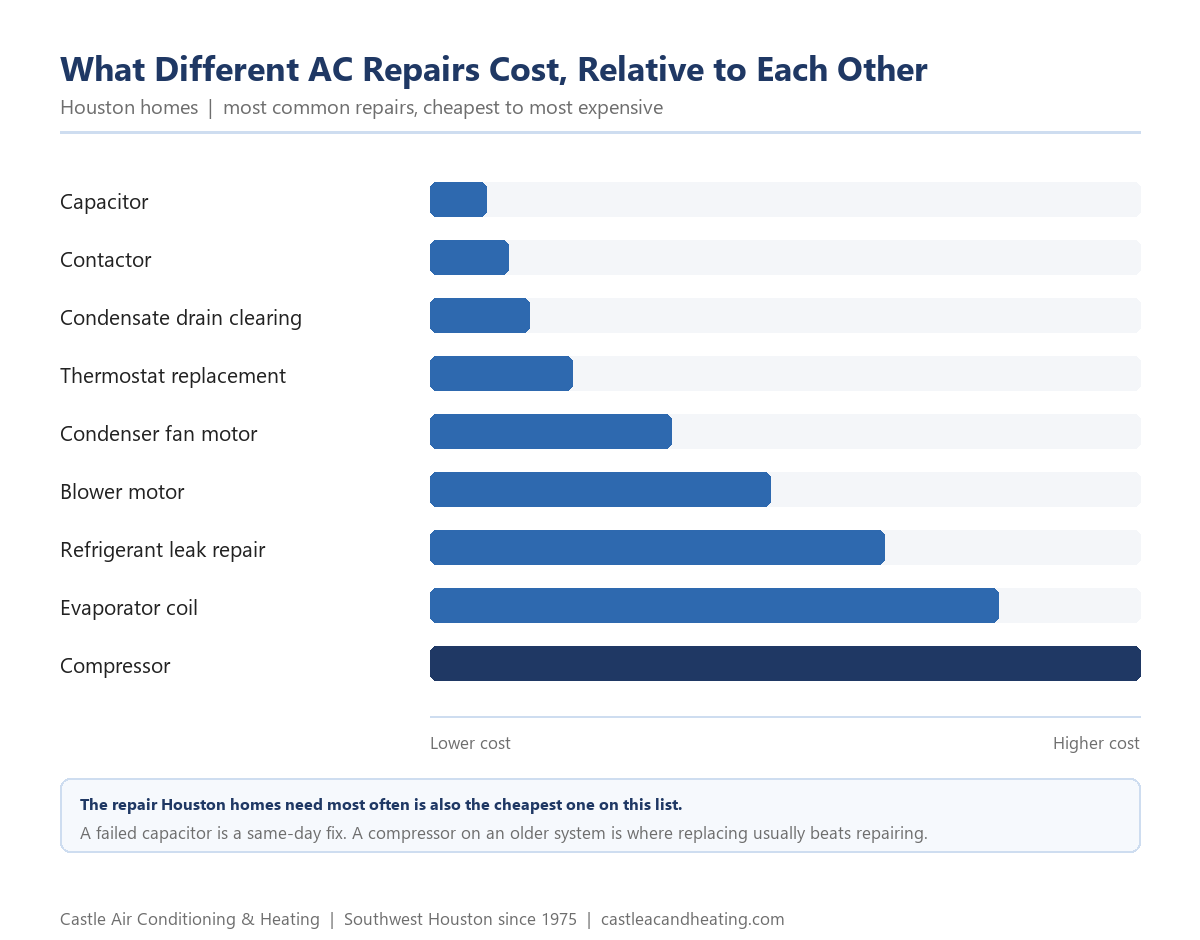
| Repair | What has failed | How common | Same-day fix? |
|---|---|---|---|
| Capacitor | The start/run capacitor on the outdoor unit | Very common | Yes |
| Contactor | The electrical switch that starts the condenser | Very common | Yes |
| Condensate drain | A blocked drain line backing water up | Very common | Yes |
| Thermostat | Failed or miswired thermostat | Common | Yes |
| Condenser fan motor | The fan on the outdoor unit | Common | Usually |
| Blower motor | The indoor fan moving air through the ducts | Occasional | Usually |
| Refrigerant leak | A leak plus recharge, not just a top-up | Occasional | Sometimes |
| Evaporator coil | The indoor coil, often corroded | Less common | No |
| Compressor | The heart of the outdoor unit | Least common | No |
Why Houston runs higher than the national averages you find online
National price guides are written for a milder climate. Three things push repairs up here.
Runtime. Our systems run from March into November. Components rated for a certain number of operating hours simply reach that number faster.
Attic air handlers. Most Houston homes put the air handler in the attic. That’s a brutal working environment in July, and it turns a straightforward coil or drain job into a longer one. It’s also why a blocked drain line here shows up as a stain on your ceiling.
Humidity. Your system isn’t only cooling air, it’s pulling water out of it. That load drives the drain-line problems, coil corrosion and frozen-coil calls we run constantly.
Why our quotes often come in under the names you hear on the radio
You know the heating and air companies advertised on Houston radio and television. The jingle you can’t get out of your head. The billboard on the way to work.
Those campaigns cost a great deal of money. Production, airtime, the agency that made them. That money has to come from somewhere, and it’s built into the price of every service call those companies run. Somebody pays for the beautiful commercial, and it’s the customer standing in a hot house waiting for a technician.
Castle doesn’t buy radio or television airtime. We’ve been working in southwest Houston since 1975, and the work has come the same way the whole time: one neighbor telling another. Two hundred reviews on Google, averaging 4.9 stars, most of them from people living within a few miles of each other.
That’s not a marketing position. It’s a cost structure.
There’s no airtime built into the number we quote you. Get a quote from us and compare it against one of the names you have heard a thousand times. We’re comfortable with how that comparison goes.
When after-hours pricing applies
A failure at nine o’clock at night in August isn’t the same call as one at ten in the morning in October. If you call us after hours, when our technicians are already home and have to come back out, there’s an additional fee, and we’ll tell you that rate before anyone is dispatched. If you call during normal hours and we’re simply running behind, so the technician reaches you in the evening, there’s no extra charge. You shouldn’t pay more because of our schedule.
If it can safely wait until morning, waiting will usually save you money. If there are vulnerable people in the house, or water is running through a ceiling, it can’t wait.
Repair or replace: how to decide
The rule most of the trade uses is to multiply the age of the system by the cost of the repair. If the result starts climbing toward the price of a new system, replacement is usually the better spend.
| Your situation | Usually the right call |
|---|---|
| Under 8 years old, first significant repair | Repair |
| Under 8 years, still under manufacturer warranty | Repair – check the warranty first |
| 8 to 12 years, second or third repair | Get both numbers before deciding |
| Over 12 years, major component failed | Replace |
| Compressor failed on a system over 10 years | Replace |
| Refrigerant leaking every season on R-410A | Replace – recharging is getting more expensive |
| Moving within two years | Repair, and keep the paperwork for the buyer |
Age, refrigerant type, repair history and how much longer you plan to be in the house all matter more than any single quote. If you’re near that line, we would rather walk you through replacement options honestly than sell you a repair that buys eight months.
How to avoid the expensive repairs
Most of the calls we run in July trace back to something that was visible in March. Coils fouled with dust. A drain line starting to block. A capacitor already reading below spec. Refrigerant slightly low from a leak nobody has found yet. None of those announce themselves until the system quits on the hottest day of the year.
That’s the whole argument for preventative maintenance. Not that it makes an air conditioner last forever, but that it moves failures out of August emergencies and into spring appointments, which are cheaper and far less miserable.
Four questions to ask before you agree to any repair
Whoever you call, these will tell you a lot:
- What’s the diagnostic fee, and do you apply it to the repair?
- Can I have the quote in writing before you start?
- Is this repair worth it given the age of my system – honestly?
- What’s the warranty on the part and on the labor?
Any company that won’t answer those plainly is telling you something.
Frequently asked questions
How much does AC repair cost in Houston?
Most repairs are a few hundred dollars rather than a few thousand. Capacitors and contactors sit at the low end and are same-day fixes. Blower motors, refrigerant leak repairs and evaporator coils cost more. Compressor replacement is expensive enough that replacing the system is often the better decision.
Do you charge just to come out and look at it?
Yes, like almost every company we charge a diagnostic fee. It covers a technician driving out and properly testing the system rather than guessing, so the repair that follows is based on a measurement instead of a hunch. The diagnostic is billed separately from the repair itself.
Why is my quote higher than the national average I found online?
National figures are written for milder climates. Houston systems run March through November, most air handlers sit in attics that reach 140 degrees in summer, and our humidity drives drain and corrosion problems that are rare elsewhere. All three push real costs above the national number.
Is it worth repairing an air conditioner that’s more than ten years old?
It depends on which part failed. A capacitor on a twelve-year-old system is still worth fixing. A compressor or evaporator coil usually isn’t, because the repair approaches the cost of a new system that comes with a warranty and better efficiency.
How much does it cost to add refrigerant?
More than it used to, and the price keeps climbing as R-410A is phased down under the EPA HFC phase-down rules. More importantly, refrigerant doesn’t get used up. If your system is low, it’s leaking. Topping it up every summer is an expensive way to avoid fixing the leak.
Does AC repair cost more at night or on weekends?
Only when the call itself comes in after hours. If you call us when we’re closed and a technician has to come back out, there’s an additional fee, and we’ll tell you that rate before we dispatch. If you called during normal hours and we’re simply running late, arriving in the evening doesn’t cost you extra.
How long does a typical AC repair take?
Common electrical repairs such as a capacitor or contactor are usually finished within an hour of the technician arriving. Blower motors and coils take longer, and a coil replacement in an attic can take most of a day.
How do I avoid expensive AC repairs?
Have the system serviced before cooling season. Most July emergencies were visible in March as a fouled coil, a blocking drain line or a capacitor already testing below spec. Maintenance doesn’t make a system last forever, it moves failures into cheaper months.
Get a real number for your system
General ranges are useful for setting expectations. They’re useless for deciding what to do about the unit in your attic right now.
If your air conditioning is down or not cooling properly, book a diagnostic visit and we’ll tell you what’s wrong, what it costs to fix, and whether fixing it’s the right call at all. Book online and you approve a written quote before any work starts. If a technician is already at your home, you get the price before the work begins and the full breakdown on your paperwork afterward. If you’d rather talk it through first, call or text 713-667-7606.
Castle has been doing this in southwest Houston since 1975 – Fulshear, Katy, Sugar Land, Bellaire, Houston Heights and the surrounding areas. Our technicians are NATE-certified, we’re licensed under TACLA #00051749C, and we quote before we work, not after.
Real homeowners, real service
Houston homeowners keep asking for our technicians by name.
Google Reviews
4.9
★★★★★
Based on 202 reviews