
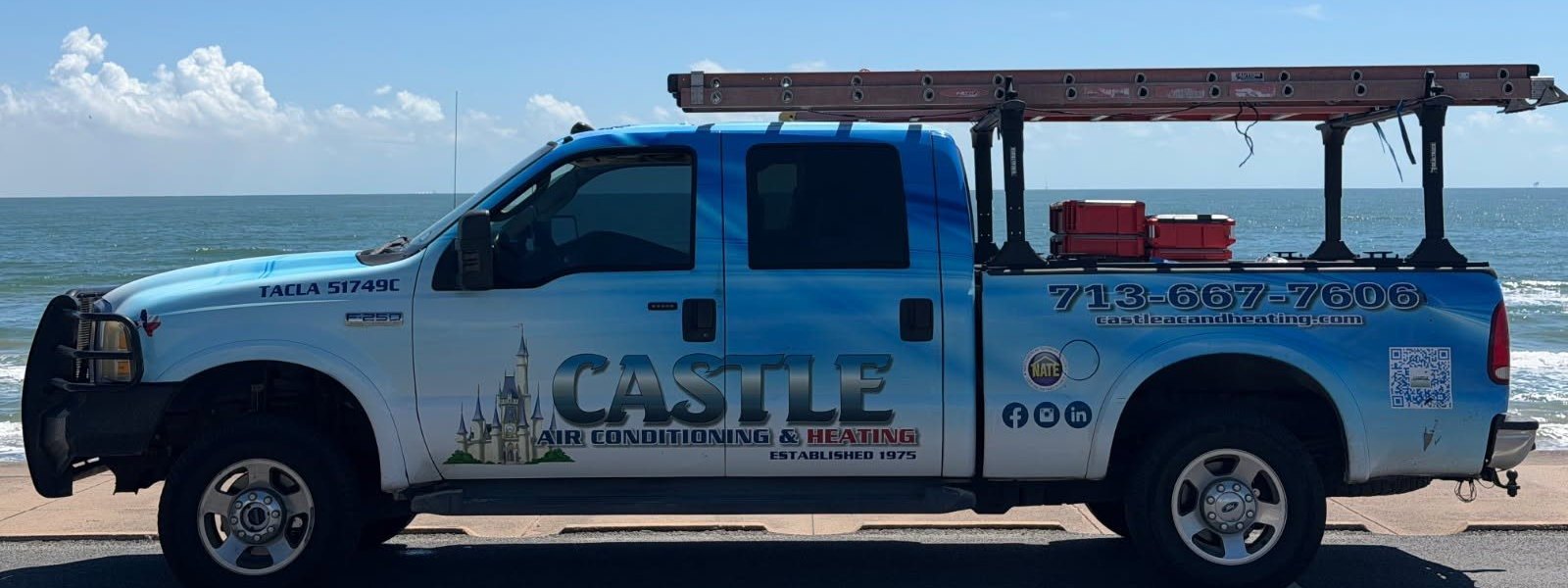
AC Repair in Galveston, TX
QUICK ANSWER
Castle Air Conditioning & Heating repairs, services and replaces air conditioning and heating systems across Galveston Island, from the Seawall and the East End to Jamaica Beach and the West End. Salt air, constant humidity and long empty stretches in rental properties are what make island systems fail differently to inland ones, and they are what we look at first. TACLA #00051749C. Call or text (713) 667-7606.
On this page
Salt air is the difference, and it is not a small one
An air conditioner on Galveston Island is doing the same job as one in Katy, in air that is actively trying to destroy it.
The outdoor unit rejects heat through a coil made of thin aluminium fins bonded to copper tubing. Salt-laden air corrodes that junction. As the fins degrade the coil loses its ability to shed heat, so the system runs longer and the compressor works harder for the same cooling. Owners usually notice the bill before they notice the coil.
On the island we expect to see it. Coils that would look fine at ten years inland can be visibly degraded at five or six here, and the closer to open water the faster it happens. Rinsing the outdoor coil with fresh water on a schedule genuinely extends its life, and it is one of the few pieces of maintenance that pays for itself in a season.
It also changes the replacement conversation. If you are replacing a system on the island, coastal-rated or coated coils are worth asking about, because the standard unit that is perfectly sensible in Sugar Land is a shorter-lived purchase here.
How long an outdoor unit typically lasts, coast versus inland
Service life of the condenser before corrosion forces replacement.
Indicative ranges, not measurements. Actual life depends on how close the property sits to open water, how exposed the unit is, and whether the coil is coastal-rated. The point of the comparison is the middle bar: regular fresh-water rinsing recovers most of what salt air takes away, and it costs nothing but a hose.
Humidity: cold but clammy
Galveston runs humid almost year round, and humidity is where a lot of island comfort complaints actually live. A house can sit at the temperature on the thermostat and still feel wrong.
That usually means the system is cooling faster than it is dehumidifying. An oversized unit is the common cause: it satisfies the thermostat quickly, shuts off, and never runs long enough to pull real moisture out of the air. Short cycling, a dirty evaporator coil or poor airflow will do the same thing.
The other consequence is what that moisture does when it has nowhere to go. Condensate drains work hard here, and a blocked one in a coastal home is the same problem it is anywhere else, only more frequent. Our guide on clearing a clogged AC drain line covers what you can do yourself before calling anyone.
Rental and second homes fail differently
A lot of island property is not lived in continuously, and systems in those homes fail in their own particular way.
A house left closed up through a humid week with the air conditioning off, or set to a temperature high enough that it barely runs, gets damp. Damp interiors are where biological growth starts, and that is an air quality problem rather than a mechanical one. We are HVAC technicians rather than remediation contractors, so what we can do is address the conditions that cause it: correct the airflow, make sure the system is actually dehumidifying, and get the drain working properly.
The other rental problem is discovery. A system that fails in an empty house is not found until a guest arrives, at which point it is urgent and it is a weekend. If you manage property here, a scheduled visit before the season is worth more than it is on a house somebody lives in, because nobody is there to notice the early signs. That is the argument for preventative maintenance in its strongest form.
Raised homes, tight spaces and short ducts
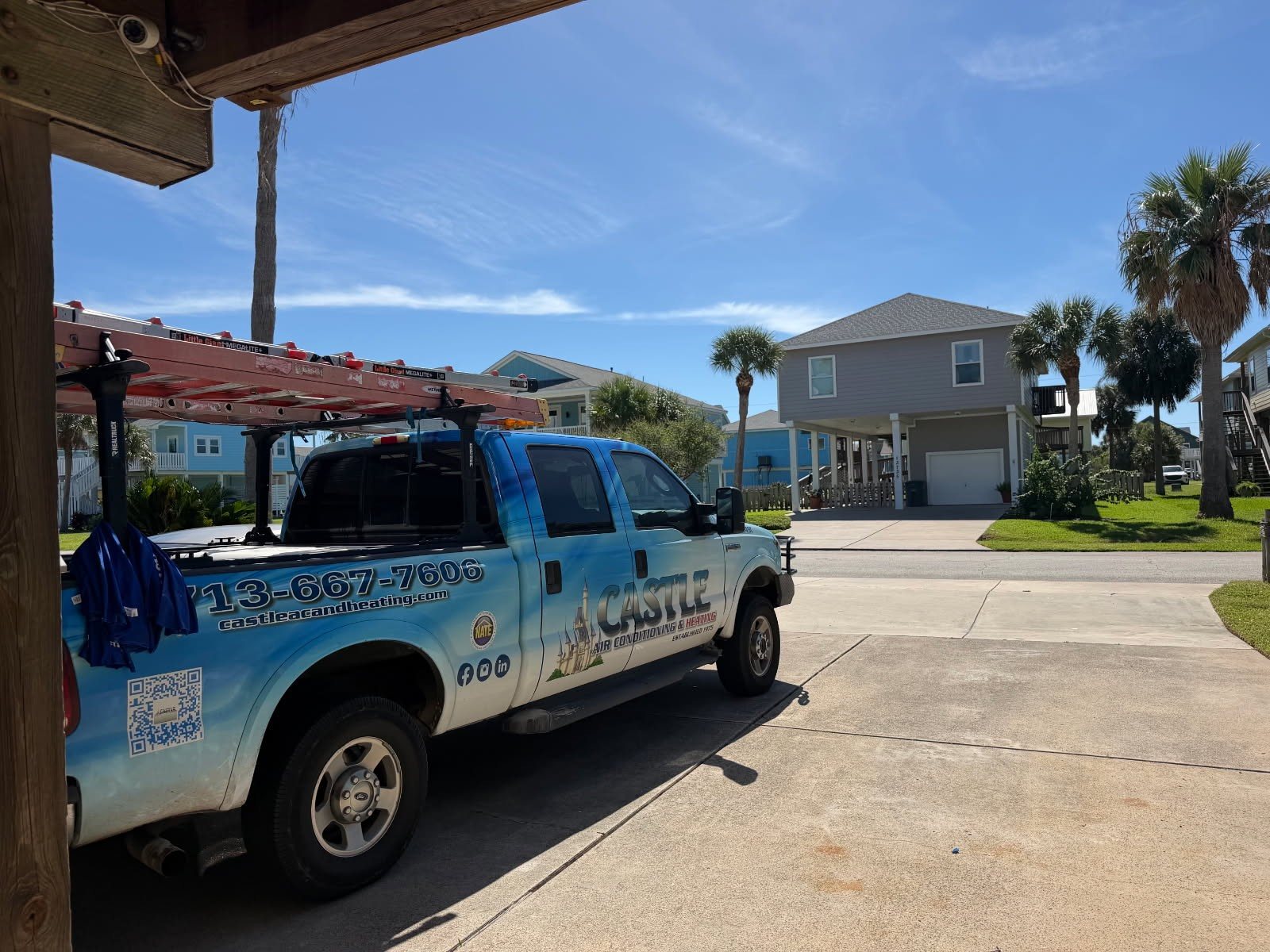
Much of Galveston is built up on piers, and that changes the mechanics. Air handlers end up in closets, in small conditioned spaces or underneath the living floor rather than in a big attic, and duct runs are often short and direct.
That is good news in one respect: you avoid the long attic duct losses that plague two-storey inland homes. It creates its own problems though. Equipment in a tight closet needs proper clearance and return air, outdoor units mounted at ground level under a raised house sit closer to blowing sand and standing water, and access for service is frequently awkward.
It is worth knowing before anyone quotes you. A replacement on a raised home is not the same job as a replacement on a slab, and a quote that does not account for access, clearance or the condition of the existing ductwork is not a real quote.
What we do on the island
| Service | What that means on the coast |
|---|---|
| AC service and repair | Diagnosis with measurement, not guesswork. Coil condition and drain performance get checked as standard here. |
| Installation and replacement | Correct sizing matters more where humidity control is half the job. Coastal-rated equipment discussed where it is warranted. |
| Preventative maintenance | Including fresh-water rinses of the outdoor coil, which is the single most useful coastal habit. |
| Heating service and repair | Island winters are short but the first cold front still finds every fault at once. |
| Mini splits | Often the right answer for a garage conversion, a added room or a space the original system never reached. |
| Indoor air quality | Humidity control and filtration, which on the island are closely related. |
After a storm
Anyone who owns property on the island knows the drill. Two things are worth saying about air conditioning specifically.
First, if an outdoor unit has been submerged, even briefly, do not switch it back on to see whether it works. Water in the electrical components and the compressor turns a possible repair into a certain replacement, and it is a genuine safety risk. Have it looked at before it is powered up.
Second, salt water is far more aggressive than rain. A unit that has taken a surge needs a proper inspection rather than a visual once-over, because the damage continues quietly after the water has gone.
Frequently asked questions
Do you really cover Galveston Island?
Yes. Galveston is part of our Gulf Coast service area alongside Seabrook, Clear Lake and the wider Bay Area. We are based in Fulshear and we work down here regularly, so it is a scheduled run rather than a special trip.
Why do air conditioners fail faster in Galveston?
Salt air. It corrodes the aluminium fins and copper tubing of the outdoor coil, and a degraded coil cannot reject heat properly, so the system runs longer and the compressor wears faster. Proximity to open water makes a real difference to how quickly it happens.
Can I do anything myself to make a coastal system last?
Rinse the outdoor coil with fresh water regularly through the season, and keep the area around the unit clear of blown sand and salt spray. It is simple, it costs almost nothing, and on the island it is the single most effective thing an owner can do.
My house is cold but it still feels damp. What is wrong?
The system is cooling but not dehumidifying. Usually that is an oversized unit satisfying the thermostat too quickly to pull moisture out of the air, though a dirty evaporator coil or weak airflow will do the same. It is diagnosable and it is fixable.
I rent my place out. How often should it be serviced?
More often than a home somebody lives in, and always before the season. Nobody is there to notice the early warning signs, so faults are discovered by a guest at the worst possible moment. A scheduled visit is what prevents that.
My outdoor unit was underwater after a storm. Can I turn it on?
No. Do not power it up to test it. Water in the electrical components and compressor can turn a repairable unit into a replacement and is a safety risk in its own right. Have it inspected first, particularly if it was salt water.
Do you offer same-day service on the island?
Often, yes, depending on where we are in the day and what the call needs. Phone or text early if you can, especially in summer. If the system is down completely, say so when you call so it can be prioritised.
Your Houston HVAC Maintenance Schedule
What should happen and when, month by month. On the island, add a fresh-water rinse of the outdoor coil to the routine and move the pre-season visit earlier.
Areas we serve
Castle is based in Fulshear and covers the Gulf Coast as well as southwest Houston, including Galveston Island, Seabrook and Clear Lake.